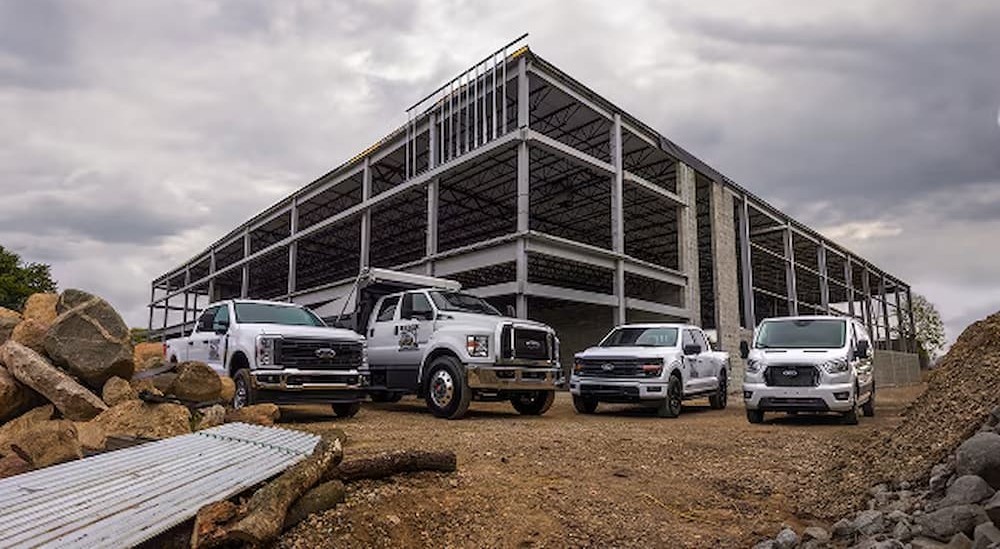
There’s a subtle strategy shift within one of America’s preeminent automakers, and it’s one that you won’t likely notice when you visit your local neighborhood Ford dealer. It’s happening behind the scenes as the company refocuses its structure and strategy while seeking to leverage success in the commercial vehicle sector to increase profits and market share. Ford will continue to develop its consumer line of SUVs and pickups, but it is increasingly focused on reinforcing the Ford Pro lineup after enjoying success in recent quarters.
In the wake of the pandemic in 2022, the automaker restructured its business approach, creating three customer-centered segments that better match current demand. While the Ford Blue and Ford Model e divisions focus on developing consumer automobiles and electrified vehicle technology, respectively, the Ford Pro segment has been tremendously profitable, offering a comprehensive suite of commercial vehicles across seven classes designed to help businesses improve productivity. Over the last three years, Ford Pro has delivered improved margins and a surging market share to the automaker, which is why Ford is now more intensely focused on the commercial sector.
Growing Commercial Business Opportunity
During the pandemic, Ford experienced a sharp decline in sales of its consumer vehicles due to a combination of factors, including a lack of consumer confidence in the pandemic-era economy and supply chain shortages for key components such as microchips. As a result, Ford restructured their business to meet the new normal, and Ford Pro was created to offer business and government agencies not only the commercial vehicles they needed but also the software and services to support them.
Driven by global factors such as the rise in e-commerce and the increasing use of last-mile delivery vehicles, infrastructure development by government agencies, and advancements in telematics and fleet management, the market for commercial vehicles is currently experiencing significant growth. While there may be temporary fluctuations in demand, the long-term forecast for the commercial vehicle segment is expected to reach $1.3 trillion by 2032, providing Ford and other commercial vehicle manufacturers with ample reason for optimism.
Offering Unified Business Solutions
Ford Pro is taking advantage of that growing segment of the automotive market by providing a full line of gasoline-powered, EV, and hybrid commercial vehicles across seven classes. However, there’s a bigger picture, as Ford Pro also offers software and telematics for managing vehicle data, administrative tasks, and driver behavior. It also includes development of, and access to, a growing infrastructure of EV charging stations that will continue to grow the commercial EV market.
But that’s not all, as the suite of Ford Pro services also includes dedicated Ford Pro Commercial Service Centers that feature large bays and extended hours to meet the needs of business fleets. When commercial vehicles require routine service, Ford Pro offers a mobile service wing that provides remote maintenance. Ford Pro also appeals to commercial buyers by offering flexible financing not only for commercial vehicles, but also for vehicle upfits and EV charging equipment.

Increased Market Share in Commercial Segments
The pivot has apparently paid off for Ford lately. Its full-spectrum fleet management and service has been attractive to commercial vehicle buyers, as Ford Pro has been able to seize significant market share in the commercial segment. For example, through July of 2025, Ford was the number one maker of commercial vehicles, with the automaker’s share of the commercial truck and van market rising to 43 percent. In another win, Ford’s share of the police vehicle market grew to 60.6 percent.
It’s not just vehicle sales that continue to increase, either. Paid software subscriptions for Ford Pro Intelligence are also up 30 percent year-over-year. The company’s BlueCruise hands-free highway software has also been popular, logging seven million hours of drive time by the end of the third quarter. The pivot has paid off, and the success has extended beyond improved sales of commercial vehicles and the accompanying services.
Increasing Profitability in the Commercial Vehicle Sector
Ford Pro’s success in the commercial segment is driving profitability for the automaker. Not only does the increased market share help offset the whims of the consumer market, but it also increases profitability. Commercial vehicles, and the services that support them, are tremendously profitable for automakers, which makes the renewed focus on the sector a savvy move by Ford.
Ford Pro is the Company’s Most Profitable Division
Commercial vehicles and the related services represent a significant profit engine for Ford, to the extent that Ford Pro was the most profitable division for the automaker throughout 2025. Commercial vehicles have a high margin, and Ford is a trusted brand that is well-regarded globally in the commercial vehicle market. Demand is high, and business owners are less likely to hesitate at pricing because fleet vehicles are business tools rather than personal investments.
Ford Pro’s profitability is further driven by the prevalence of its software subscription services and mobile service and repair capabilities. Software subscription services generate predictable, steady revenue, as customers only need to be sold on the subscription once, and revenue is generated via recurring payments. Also, mobile service further increases the efficiency of repair and maintenance costs. Ford Pro’s system plays a more significant role in fleet maintenance by scheduling routine service needs and predicting future repair needs, leaving less room for uncertainty.
Recent Profit Successes
These factors have combined to make Ford Pro the most profitable division within the automaker’s current structure. Though Ford Pro’s $17.4 billion in revenue is only about half that of Ford Blue’s $28 billion in revenue for 2025, its profitability is much higher. Considered a key profitability metric, the most recent EBIT (Earnings Before Interest and Taxes) metric for Ford Pro is $1.985 billion thus far in 2025. That outpaces Ford Blue’s EBIT of $1.54 billion while representing a smaller share of overall revenue. This is one of the many reasons that Ford is leaning into its commercial successes, expanding its product, subscription, and service offerings to meet the continuing rise in demand within the commercial sector.
Strategic Shift in Consumer Automotive Lines
The shift in focus to commercial sales and service isn’t an accident. It comes at a time when sales within Ford’s consumer segment had become increasingly unpredictable. This has led the automaker to divide its attention between consumer vehicles, such as trucks and SUVs, which continue to be profitable, and its commercial vehicle sales platform, which is forecast to remain a profit center for the company for years to come.

Sunsetting of Sedan Lines
Following years of declining sales, Ford officially sunsetted all the sedans in its North American line of automobiles, leaving mostly trucks and SUVs to support consumer sales. In fact, the only remaining car available from Ford is the Mustang, which has experienced declining sales in the U.S. in the last year despite remaining a top-selling sports car globally. However, even the venerable Mustang has had to adapt to changing consumer whims, as an all-electric SUV version of the car, the Mustang Mach-E, is now available.
The rise of the SUV has made the traditional American sedan almost obsolete. As a result, Ford now fields six SUV models (seven if you count the Mustang Mach-E) to meet evolving consumer preferences. Ford trucks continue to be best-sellers in the North American market, as the F-Series continues to be America’s top-selling full-size pickup, while the Maverick performs well with little competition in a compact truck market built on efficient yet capable pickups.
Increased Investment in Commercial Lines
With the streamlining of Ford’s consumer lineup, the automaker has chosen to pour resources into the development of commercial vehicles and services. That robust investment is expected to continue as Ford builds towards an electrified future, exploring ways to maintain commercial vehicle market share while developing all-electric commercial vehicles and infrastructure.
This long-range strategy is wise and ensures Ford Pro will continue to enjoy profitability in the years to come. From a business perspective, commercial electric vehicles make sense. Modern EVs are reliable and powerful, which means less time off the road for service and more time handling dedicated tasks that drive business. They also have a reduced environmental footprint, which is an important consideration for many businesses in today’s eco-friendly climate. The need for more environmentally friendly commercial vehicles will only grow in the future. Electric and hybrid vehicles can also help mitigate one of the main sources of overhead for the businesses that rely on them, namely, the rising price of fuel for vehicles powered by internal combustion.
Ford Sets the Stage for Continued Growth of Commercial Business
Ford’s new focus on commercial vehicles, especially EVs and the infrastructure needed to support them now and into the future, comes at the perfect time. By trimming the fat from its consumer lines and focusing on the profitability of commercial vehicles under the Ford Pro umbrella, the automaker can become leaner and meaner as it moves into a future rife with shifting market factors. There’s little doubt that the demand for commercial vehicles will continue to grow in the coming decade as e-commerce continues to flourish, and fleet managers seek not only reliable vehicles but streamlined one-stop shopping for software and services to support them.