What’s in a name? This Shakespearean query is as relevant today as it was back in the late 16th century, especially if you’re trying to be a savvy consumer. With major brands spending millions on flashy ad campaigns aimed at prying open your wallet by any means necessary, buyers need to have their head on a swivel when it comes to separating fact from fiction. This is especially true in the auto industry, where new technology is often billed beyond its actual ability. Just take self-driving vehicles, for example. Many modern cars, trucks, and SUVs are designed with advanced hands-free technology that can handle most driving duties, but there’s a notable difference between “hands-free” and true self-driving.
That hasn’t stopped Tesla from introducing its own Full-Self Driving (FSD) system, which, despite the name, lags behind hands-free offerings from Ford, GM, and BMW in terms of true functionality. What is Tesla’s FSD feature? How does it differ from the basic Autopilot function? Can it compete with increasingly complex hands-free offerings that have made their way to market in recent years? We’ll answer those questions and explore Tesla’s history of overhyped tech as we dive into the brand’s FSD system.
FSD Explained
Before we dive into the intricacies of the FSD system, we need to take a moment to compare it to Tesla’s standard Autopilot package. While the name suggests a sophisticated system, the truth is Autopilot isn’t really that different from the suite of advanced driver assistance systems (ADAS) you’ll find in every recent car, truck, or SUV. The basic package includes adaptive cruise control, lane keeping assistance, blind-spot warning, and forward collision mitigation.
Autopilot simply leverages two of these features, adaptive cruise control (Traffic-Aware Cruise Control in Tesla-speak) and lane-keeping assistance (Autosteer), to keep your EV firmly planted in its lane. The system was involved in a fatal crash back in 2017, forcing Tesla to clarify that, despite the hype, these systems are not legally driving the vehicle. While the term “Autopilot” might be a bit of a stretch to describe such a run-of-the-mill system, branding has always been Tesla’s forte.
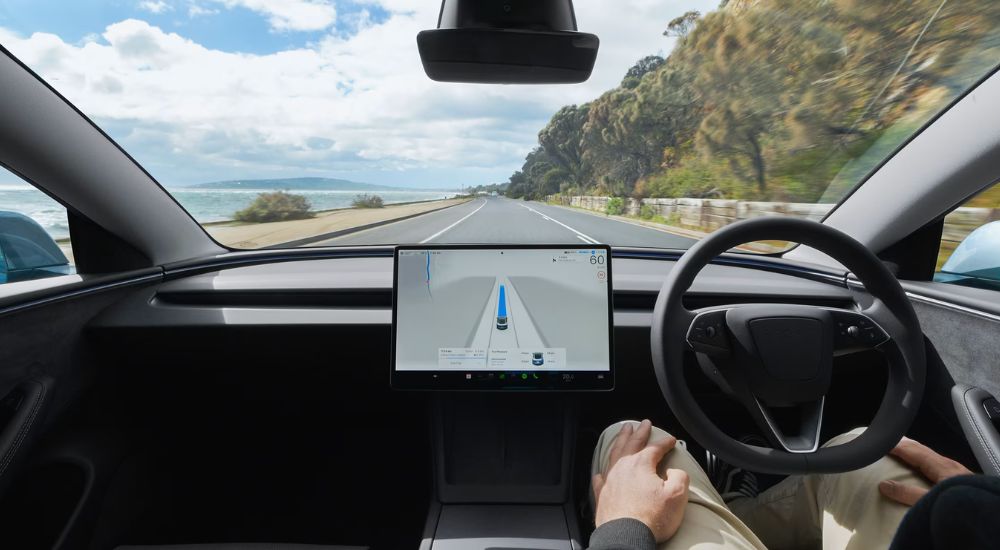
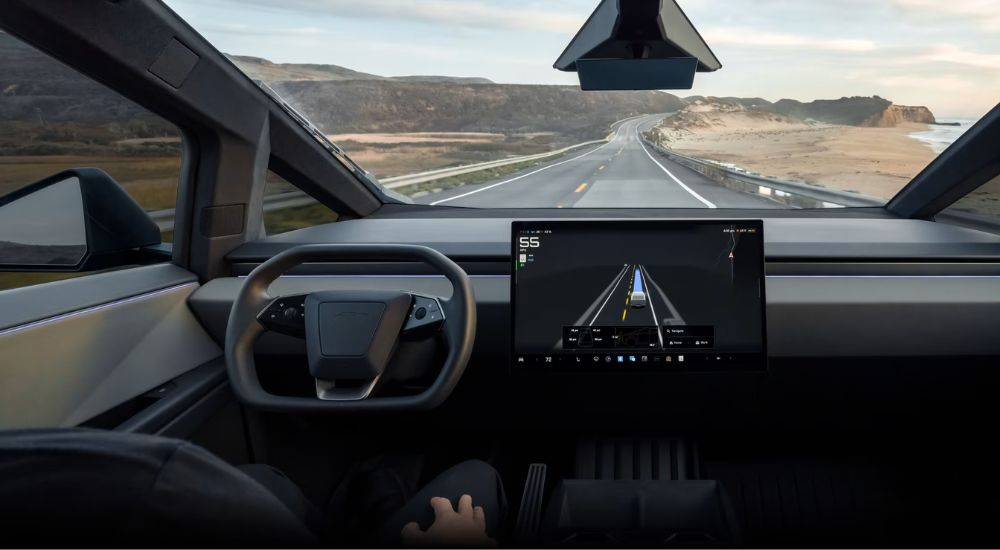
That brings us to Full Self-Driving. We’ll start by noting that FSD is not a true autonomous, driverless system. Like most other hands-free offerings on today’s market, FSD is considered to be Level 2 automation. While these systems can handle most of the accelerating, braking, and steering duties, and even complete automatic lane changes, they still require an attentive driver at the helm who can take control if needed. The system also cannot offer true hands-free operation. It can’t reliably handle all weather conditions, as its cameras are prone to being obscured. It can’t navigate complex scenarios, such as unusual intersections, detours, and roundabouts. It can’t even operate with faded or obstructed lane markings. Most importantly, so-called Full Self-Driving does not eliminate driver liability in the event of a crash.
Tesla’s FSD sweetens the pot with a few premium features, like automatic parking, GPS connectivity, and the ability to read and respond to traffic lights and signs, but it’s not truly hands-free in the strictest sense. This is what’s known as a “supervised” system, with said supervision provided by an interior camera that tracks the driver’s eye movement. Recent updates have moved the system toward greater hands-free operation, but FSD still lags behind other systems in terms of pure functionality.
While Ford’s BlueCruise, GM’s Super Cruise, and BMW’s Highway Assistant allow drivers to remove their hands from the wheel as long as they remain attentive, Level 2 systems from the likes of Hyundai, Subaru, Volvo, and Rivian all require drivers to keep their hands firmly planted on the steering wheel. FSD requires a hand on the wheel as well. While many drivers have reported hands-free operation, the owner’s manual begs to differ. A recent update has seen Tesla’s system take a more relaxed approach, but the eye-tracking camera still requires drivers to place their hands on the wheel if it detects a sufficient distraction.
The difference between Tesla’s system and the hands-free tech championed by GM and Ford comes down to how each brand has approached the task. The older automakers have built their tech around pre-mapped highways, which, while labor-intensive, do provide a reliable foundation for hands-free coverage. Super Cruise currently covers some 750,000 miles, while Ford’s BlueCruise can be used on 130,000-plus miles of premapped “Blue Zone” highways.
Tesla has embraced a more vision-based approach that leverages a network of sensors, cameras, and radar to map the road in real time. While this means that FSD’s coverage is technically infinite, it’s also bound to be a bit more error-prone than GM and Ford’s technology. Tesla’s approach might win out in the long run, but given the current state of hands-free tech, BlueCruise and Super Cruise are a little more reliable here and now.
Making The Jump To Level 3
FSD is a significant improvement over the old-fashioned approach, but it’s not exactly the seamless system that’s been forecasted by decades of sci-fi films. That said, the hands-free future is now. You just can’t experience it behind the wheel of a Tesla. German luxury brands Mercedes-Benz and BMW have both rolled out some early Level 3 systems. Honda isn’t far behind with its Honda Sensing Elite, but there’s some fine print that’s worth reading before you break out your checkbook.
These Level 3 systems are pretty limited in terms of both when and where they can be used. BMW’s Personal Pilot L3 system is currently limited to 7-Series models sold in Germany, while Honda Sensing Elite is only available on the Japanese-market Legend. Mercedes-Benz DRIVE PILOT is the only system available in the U.S., and even then, it’s limited to California and Nevada. Drive Pilot is also limited to just 40 mph, which makes it a bit impractical for highway scenarios.
It might be slow going at the moment, but the future is bright when it comes to Level 3 tech. GM plans to introduce its first Level 3 system on the 2028 Cadillac Escalade IQ, and Ford’s take on the tech could grace the brand’s new electric pickup set to be released in the same year. The Mercedes-Benz DRIVE PILOT will continue to expand its coverage and availability, and Stellantis has developed an AutoDrive function that could find its way into future models. The Chinese market is also all-in on the hands-free trend, with companies like Xpeng and Zeekr leading the way.

Tesla’s Tumultuous Tech
This certainly isn’t the first time Tesla has failed to meet expectations with advanced driving tech. The automaker has a rather sordid record of delivering promised features, especially in full self-driving and other forms of automation. Some notable highlights include:
- 2013: Tesla CEO Elon Musk tells the Financial Times that the company will build a self-driving car within three years. While the company’s Autopilot advanced driver assistance system (ADAS) hit the market in 2014, Tesla’s Full Self-Driving feature didn’t even enter the testing phase until 2020.
- 2016: Tesla announced that it would complete a full self-driven trip across the U.S. in 2017. This trip never happened, though a Tesla owner did achieve the journey in 2026 using the FSD feature.
- 2016: Tesla announced a “Smart Summon” feature that would allow vehicles to autonomously self-park and navigate parking lots. The feature did materialize in 2019, but it performs inconsistently and requires constant supervision.
- 2019: Musk said drivers would be able to sleep in their self-driving Teslas while they traveled by 2020. No vehicle has achieved this feat as of 2026, and even advanced Level 3 systems don’t allow for sleeping drivers.
- 2019: Tesla predicted that it would have 1 million robotaxis on the road by the end of 2020. While the company does operate a small fleet in both Austin and San Francisco, these use the Level 2 FSD technology and are often overseen by a human operator.
- 2020: The company announces an affordable, $25,000 EV to be released within three years. The cheapest Tesla model currently retails for $36,000.
This is just a small sample of Tesla’s spotty track record, and it raises an interesting question: why do buyers keep flocking to the brand? While sales have slowed across the all-electric segment, Tesla’s Model Y is still the industry’s bestselling EV with 350,000 units moved in 2025 alone. Tesla stock also reached an all-time high in early 2026 despite two consecutive years of declining sales.
There’s no doubting Tesla’s role in advancing the EV segment. The automaker continues to be a leader in all-electric automotive tech and has delivered its fair share of industry-defining products over the last two decades. That said, there’s often a noticeable gulf between reputation and reality when it comes to the EV brand.
There are many ways to characterize this approach, and some are kinder than others. A generous take might describe Tesla as a sort of vision-driven disruptor that has singlehandedly advanced the EV cause. It would be equally fair to paint the company as the undisputed master of the overpromise-and-iterate model, where bold claims outweigh concrete results. The truth probably lies somewhere in the middle, and perfectly encapsulates the hype-driven Silicon Valley model that’s often divorced from economic reality.
Of course, the automaker’s polarizing CEO is also a big part of the Tesla story. While Musk’s bold predictions, constant tweeting, and controversial foray into politics have led to plenty of frustration for stockholders, money talks. The world’s richest man has deep pockets, important connections, and a relatively cozy relationship with the current presidential administration, which all help to insulate Tesla from wider market forces and a consistent string of overhyped features and products.
Tesla might not be the trailblazing tech giant in hands-free tech, but it’s very good at branding. From outside-the-box names like the Model Y, 3, X, and Cybertruck to the Gigafactory production facilities and pop culture-inspired features like Ludicrous and Plaid driving modes, Tesla knows what it takes to make an EV stand out in an increasingly crowded market. However, the company also gets itself into a little hot water with these memorable monikers. The term “Autopilot” implies a level of automation that the typical Tesla simply doesn’t possess. “Full Self-Driving,” while technically true, comes with some important caveats that might seem like a bit of bait-and-switch for the average buyer.
FSD is hands-free, but that’s not really that remarkable in today’s automotive landscape. The real gold standard is a true hands- and eyes-free system that, so far, has been mastered only by Honda and the aforementioned German brands. Tesla’s real-time approach to hands-free tech might be the limiting factor, but even the most technologically advanced car would struggle to meet the lofty expectations set by the chronically braggadocious brand.