Many consumers are excited to experience the latest technology, but some are slower to adopt new trends. From smartphones and new social media platforms to other apps and software, there will always be those on the hunt for the next big thing, while others are content to fall behind.
The technology adoption curve describes how new products are embraced by the public over time, with innovators giving way to early adopters, the early majority, the late majority, and laggards. Today’s all-electric vehicles (EV) serve as a perfect example. While EV models have certainly come into their own in recent years, the technology hasn’t quite followed the adoption curve that many automakers expected. Innovators and early adopters might have welcomed early EV models with open arms, but convincing the mass market to switch from traditional gas-powered vehicles to a new era of all-electric vehicles has proved quite tricky.
This creates an interesting dynamic as we enter the 2027 model year. Drivers have been voting with their wallets. While EV affordability, infrastructure, and acceptance have been rising, all-electric models are still losing ground to their hybrid competitors. Automakers aren’t about to abandon their electrification efforts, but they are broadening their approach by placing a renewed emphasis on hybrid technology as EV sales have stagnated.
What’s the state of the hybrid and EV segments as we cruise into 2027? Which technology is poised for better growth, and how are automakers reacting to an ever-changing market? We’ll make sure you’re plugged in on all of the latest details as we dive into all that and more.
Hybrids Are Having a Moment
You don’t have to dig too deep into the data to realize that hybrids are having a moment. Hybrids, plug-in hybrids (PHEVs), and EVs now account for 24% of the market, but the split may be surprising to some. While hybrid models gained a little market share in the second quarter of 2026, representing 16% of all new light-duty vehicle sales, EVs actually lost a point, falling from 7% to 6% over the same period, while PHEV sales also declined slightly.
Buyers have warmed to the benefits of a little electrification, especially for efficiency, with modern hybrid models averaging around 42 MPG combined. That’s not a dramatic improvement in pure fuel economy compared to older hybrid offerings, but it’s significant when you consider the larger models that have entered the segment over the last decade.
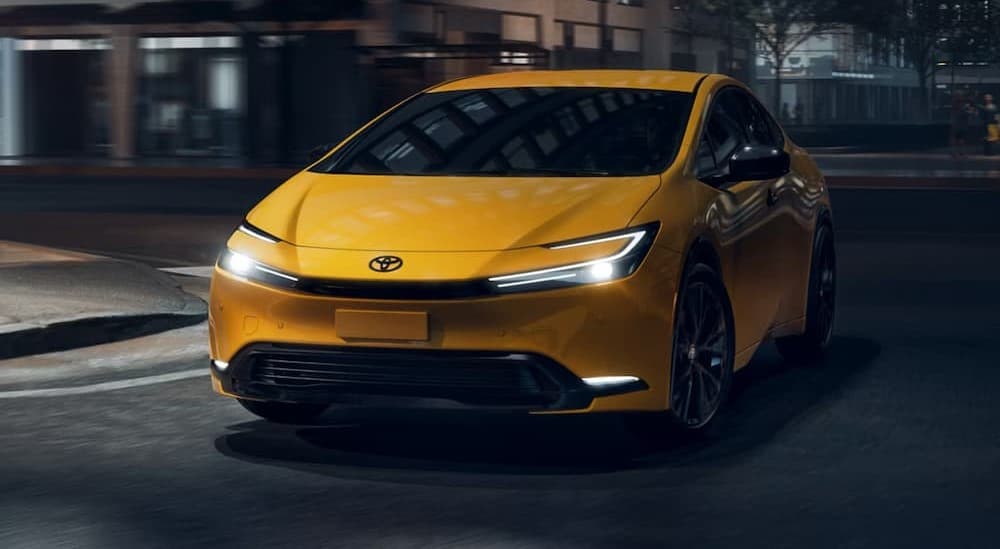
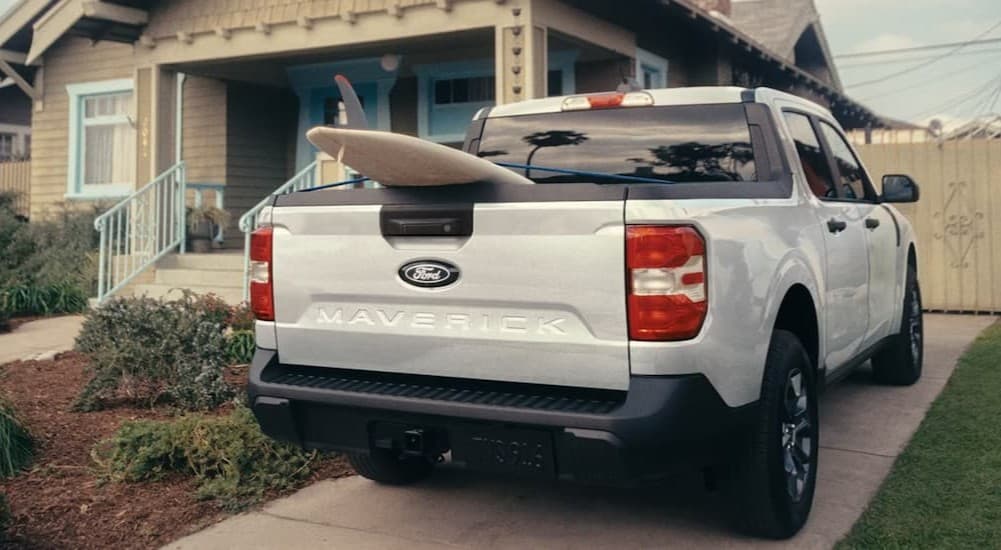
Early hybrids were usually limited to compact sedans and small crossovers, but as the technology matures, larger crossovers, full-size SUVs, and even pickup trucks are getting in on the fun. That 42 MPG figure isn’t too impressive for a compact Prius sedan, but a Ford Maverick pickup that can achieve 42 MPG in the city and tow up to 4,000 lbs is tough to ignore.
It’s easy to understand the appeal of a modern hybrid. The technology allows drivers to enjoy all the benefits of electrification without the lifestyle changes that come with an all-electric model. Unlike EVs, you don’t need to worry about sticking to a charging schedule or investing in the necessary equipment. However, the performance benefits really move the needle for power-hungry drivers.
Just take the original hybrid champion in the Toyota Prius. The 2005 model made just 110 hp, but the 2025 model sees that number rise to nearly 200 hp. Early hybrids put efficiency front and center, but new, larger electric motors and batteries, gas engines, and increasingly efficient electronics have enabled hybrids to enhance performance and deliver a dynamic driving experience.
Hybrid technology has also become more diverse. Traditional hybrid electric vehicles (HEV) currently dominate the market. While plug-in hybrid (PHEV) models lost a little ground in the last year, with market share slipping from 1.9% to 1.4%, a new wave of extended-range electric vehicles (EREV) holds a lot of promise.
Meanwhile, EV sales have slowed after peaking just a few years ago. Nearly 1.2 million EVs were sold in the U.S. in 2023, representing a 48% improvement over the previous year. That figure fell to just 7.3% in 2024 and looks flat, if not slightly down, as 2025 numbers roll in. Prices have remained relatively steady, but concerns still persist about charging infrastructure, time, range, and cold-weather performance. Throw in the economic uncertainty that’s touched every corner of the U.S. market, and it’s a tough time to make a case for the EV.
Some Automakers Are Changing Course…
How are automakers dealing with the shifting demand for electrified vehicles? The reactions really run the gamut. While some are making a noticeable pivot to hybrid tech, others are sticking to their original EV plans, for better or worse.
U.S. auto giants Ford and GM serve as prime examples of the first approach. While both brands had made ambitious plans for new EV models and invested billions in the effort, slowing sales have prompted them to scale back their all-electric push in favor of a more flexible strategy.
In mid-2021, GM announced a goal of selling more than 1 million EVs annually by 2025 as part of a $35 billion investment in new technology. The brand’s new Ultium platform was supposed to power GM’s all-electric future, but a rapidly changing market led GM to abandon that goal and write off billions in EV investment as it scaled back its plans. GM actually wrote off $7.9 billion in 2025 alone, which shows just how dramatic some of these losses have been.
It’s a similar story at Ford, where the Big Blue Oval has written off billions related to its EV plan. A canceled three-row SUV led Ford to take a charge of around $400 million back in 2024, but 2025 brought the biggest financial failure. Last year, Ford took $8.5 billion in pre-tax write-offs tied to canceled EV models, and another $3 billion to restructure its battery-building partnership with South Korea’s SK On.
That said, Ford is still moving ahead with an affordable new EV pickup built on its Universal EV platform. Slated to debut in late 2027, the Fathom will retail for less than $30,000. The pickup will have to compete with a new all-electric upstart in the Slate Truck, which is heavily backed by billionaires Jeff Bezos and Mark Walter.
Both GM and Ford are now trying to diversify their electric offerings, supplementing their existing lineup with lower-cost EVs, hybrids, PHEVs, and a new generation of extended-range electric vehicles (EREV) that could offer the best of both worlds. These EREVs are essentially a sophisticated type of hybrid where the gas engine is solely responsible for keeping the battery charged, rather than driving the wheels. This allows drivers to enjoy all of the benefits of an EV, such as instant torque, quiet performance, and low operating costs, without the range anxiety that comes with the typical all-electric model.
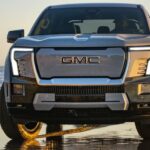
The Ford F-150 Lightning was one of the market’s first all-electric pickups when it debuted back in 2022, but it largely failed to live up to the hype in terms of sales. The truck was discontinued in 2025, but will return as an EREV model in the near future. The EREV approach is particularly well-suited to larger models like pickups and full-size SUVs, and could soon become a big part of the GM lineup.
Hyundai, Kia, and Genesis are also getting in on the action with a roster of large SUVs set to be powered by EREV tech. The Hyundai Group brands will also continue to champion EV and hybrid models, but EREV adds a new arrow to the automaker’s electric quiver.
…While Others Stick to Their Guns
It’s a whole different story at Honda and Toyota. The two Japanese brands took a more wait-and-see approach to EV technology, opting for a hybrid-first strategy that now looks a bit prescient in hindsight.
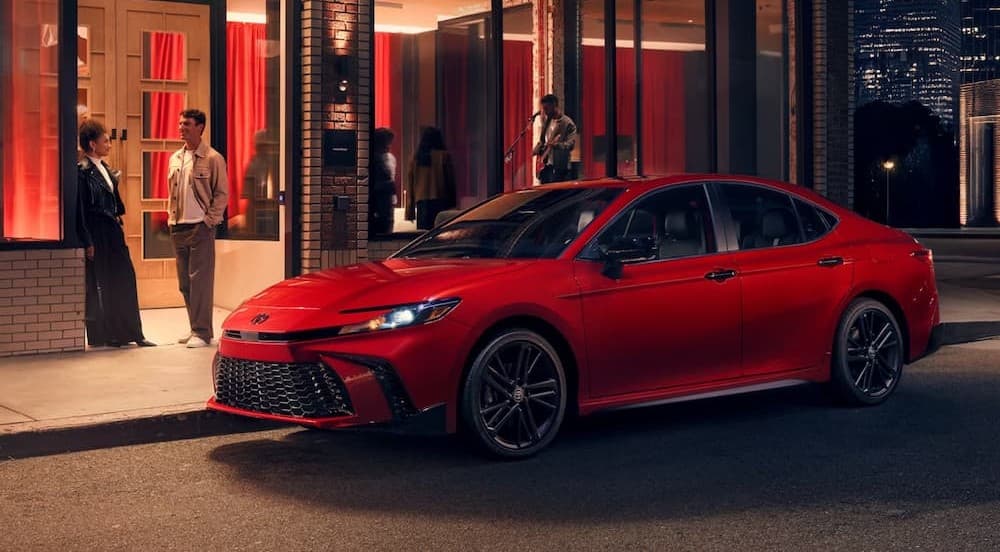
Toyota was one of the pioneers of hybrid tech here in the U.S., dating back to the 2001 Prius. It has long stuck to its guns, while other brands have gone all in on the EV wave. The company has introduced a few all-electric models, such as the bZ and the revived C-HR, but its hybrid models are having the biggest impact on the bottom line. The popular Camry went fully hybrid in 2025, joining a growing list of hybrid-only models like the Prius, Crown, Crown Signia, and Sienna minivan.
Honda was arguably the furthest behind the curve when it came to EV models. In fact, the brand’s only real EV was the Prologue, a joint effort developed with GM and built on GM’s Ultium platform. The automaker does offer a plug-in hydrogen fuel cell electric vehicle in the confusingly named Honda CR-V e:FCEV, but the model is limited to the California market.
Having not sunk significant funds into a full EV lineup, Honda now has the financial flexibility to aggressively pursue its hybrid plans as sales slow in the all-electric market segment. The brand will roll out 15 next-generation hybrid models globally by 2030, starting with volume sellers like the Civic, Accord, and CR-V. Large hybrid SUV models will join the lineup later in the decade.
Honda hasn’t entirely abandoned its EV plans. The Honda 0 Series would have seen the automaker introduce seven new EVs globally by 2030, including the Honda 0 SUV, Honda 0 Saloon, and Acura RSX, but that’s now been reduced to a single model in the Honda 0 α (Alpha). The kicker is that it won’t even be available on the U.S. market, with Honda currently limiting its scope to the Indian and Japanese markets.
The EV Isn’t Dead Yet
Ford/GM and Honda/Toyota occupy opposite ends of the spectrum in their EV and hybrid strategies, but other brands have largely stuck with established plans. Volkswagen, Mercedes-Benz, and other European brands continue to invest in all-electric models despite the data.
Only time will tell which strategy will show out, but the recent upheaval in the EV market clearly proves one thing. Advancements in automotive technology don’t always follow a straight line. While the hybrid to EV pipeline once seemed pretty straightforward, changing consumer demands, new technology, and shifting market conditions have led to a few detours along the way.
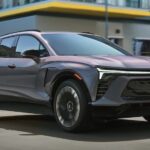
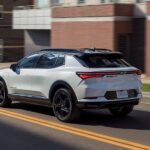
Hybrids clearly have the most momentum in the short term, and PHEV and EREV models represent a good middle ground. However, even as EV sales have slowed, it’s hard to imagine a scenario in which EVs don’t eventually become the go-to option in the U.S. market. The EV appeal only grows as charging infrastructure improves, and a new wave of ultra-affordable models like the Chevy Bolt could ultimately be what it takes to tip the scales in favor of large-scale EV adoption.