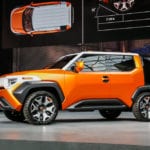
Many readers, especially the millennials who were their target demographic, remember the Scion brand of automobiles once produced by Toyota. Created in the early 2000s to attract younger car buyers, Scion focused on small, sporty cars that were trendy and stylish, had great performance, and didn’t follow the established rules of sales and marketing. The Scion FR-S is credited with helping RWD sports coupes become popular again, and its experimental spirit has earned it a cult following. Unfortunately, the brand was shuttered in 2016, and that seemed to be the end of it.
Imagine our surprise in November 2025 when Toyota announced it would display a new Scion concept at the annual Specialty Equipment Market Association (SEMA) show, a long-standing automotive hotbed. Not only was the concept not a sports compact, but it wasn’t even a road vehicle. Instead, Toyota had attached the name to a hybrid all-terrain vehicle from its recently formed non-traditional vehicles division. To put it bluntly, what in tarnation was going on? As it turns out, the seemingly sudden shift makes some sense, and it could be a sign of things to come for Toyota.
The Scion of the Past
Understanding the origins of the Scion marque makes its new direction more understandable. The name was born of Project Genesis, an effort to give certain vehicles an edgier feel that would appeal to young people in the U.S. while staying within their price range. (The project also encompassed Toyota-branded models like the Echo, Celica, and MR2 Spyder.) The lineup consisted entirely of compact and subcompact sedans, hatchbacks, and coupes with sporty or boxy designs. As part of the experimental philosophy, almost all Scion cars had two-letter names, such as the tC, xB, and iA.
Beyond the cars it made, Scion attempted to change the way they were sold and marketed. The brand introduced transparent, non-negotiable pricing, which many dealerships have since adopted. It also offered each model as a single trim level, letting customers spec the cars from there with dealer-installed accessories, which you now see offered on vehicles like the forthcoming Slate EV truck. Marketing focused on viral and guerrilla techniques that were then novel but have since become widespread. It even went into the music business to spread the word.
Perhaps Scion was simply ahead of its time. But for all its efforts, the sales simply weren’t there. After a solid first few years, numbers plunged, and multiple attempts to reverse the trend were unsuccessful, leading to the brand and its remaining vehicles being folded back under the Toyota name after 2016. For that matter, the entirety of Project Genesis is considered a massive flop. The Celica and MR2 Spyder were abandoned in the mid-2000s, while the Echo was rebranded as the Yaris and survived on North American soil until 2020.
The Scion of the Present
Suddenly, Scion is back. Toyota described the Scion 01 Concept as a “bold reimagining” of the side-by-side (SXS) vehicle and an exercise to explore what is possible for all-terrain performance. Toyota has a long history of off-roading, with the original 1951 Land Cruiser kickstarting this timeline. Since then, trucks and SUVs like the Tundra, Tacoma, and 4Runner have emerged as iconic Toyota trail rigs.
Now, Toyota looks to join Honda, BMW, and Ducati/Volkswagen as major automakers that have also thrown their hats into the powersports ring. Interestingly, much of the technology on the Scion 01 Concept ATV has been taken from the Tacoma midsize truck. This includes the 300-plus hp turbo I-4 hybrid powertrain based on the Tacoma’s i-FORCE MAX. It also has a silent EV mode that minimizes noise, so the driver can avoid scaring wildlife and annoying neighbors.
This concept SXS also borrows its suspension, brakes, and drivetrain from the Tacoma, meaning excellent capability for everything from rock crawling to high-speed thrills. Using truck components also greatly improves reliability for extreme conditions and multi-day trips. The other big highlight is an FIA- and SCORE-approved roll cage, meaning the Scion 01 is theoretically competition-ready and offers additional protection for serious off-roaders. Of course, there are also classic SXS elements like the knobby tires and open-air windows.
As of now, the Scion 01 Concept is just that, a concept. This is usually the case with concept vehicles, though, as they instead serve as the foundation and inspiration for future production models. Nonetheless, Chief Engineer Don Federico told Road & Track recently that he is “trying to build a case” to eventually release the Scion 01 as a commercially available SXS.
Why Is Scion Going Off-Road?
This is the big question so many people are asking. It’s relatively uncommon for a shuttered brand to be reborn, and even more rare for the brand to go in a completely different direction. Between Toyota/Scion’s public statements and my own reading between the lines, I think I’ve been able to make sense of it all.
First, there is no longer a need for a separate Scion name to interest America’s youth in on-road cars. Toyota said as much when it discontinued the Scion marque. Since then, the FR-S has enjoyed a second life as the Toyota 86. The GR variant, spawned by Toyota Gazoo Racing, has proven wildly successful, reinvigorating nameplates such as the Corolla, Supra, and (overseas) Yaris. When you add newer EVs like the C-HR and bZ4X, Toyota has clearly hit on the right formula under its own name.
Second, this non-traditional vehicles project appears to be very much in the original spirit of the Scion name. As Federico said, the SXS concept is “getting back to the roots of Scion, which was supposed to be this test laboratory.” Everything about Scion, from the vehicles it made to the naming conventions, marketing strategy, and sales models, was about trying things out. It provided an opportunity to live outside of traditional Toyota branding, and adopting the Scion name shows the company is ready to do so in another field.
Furthermore, it sounds like the Scion name will be applied to more than just off-road concepts. Federico noted the goal is to develop a variety of non-traditional vehicles, which might include low-speed vehicles, autocycles, and even some “things that aren’t vehicles.” Toyota is now looking at Scion, a name that once carried the torch for youth-oriented vehicles, as a name that will drive interest and sales as it expands into other markets.
The Scion of the Future
All this appears to be part of Toyota’s larger vision, seeing itself not just as an automobile company but as a mobility company. Its Woven City test course in Japan officially opened in September 2025, and Toyota is open about how it’s developing advanced automation software to power driver assistance technology and connectivity. Although it’s not abandoning traditional vehicles, Toyota is working to position itself as a leader into the future.
I like to think of developing a truck-based SXS as a kick-start to the next generation for Scion. The first generation aimed to change how younger audiences thought about cars, and the second generation will aim to change how people think about alternative forms of transportation. It will be fascinating to see where the Scion name turns up over the next few years.