For a certain type of automotive purist, there’s just no substitute for the hearty roar of a beefy V8, or even the high-pitched whistle of a turbocharger as it spools up to provide a V6 or I-4 engine with an extra boost of power. That creates a bit of an issue in the EV segment. While today’s all-electric vehicles enable drivers to enjoy a new era of efficiency and power, they lack the distinctive din of their internal-combustion counterparts. Luckily, brands have developed a modern solution to this modern problem in the form of simulated engine noise.
They say imitation is the sincerest form of flattery. While there is something a bit silly about the new wave of EV models imitating an increasingly outdated form of automotive technology, there are some important safety and marketing factors at play. Let’s put our ear to the ground and learn a little more about the rise of Active Sound Design (ASD) in today’s all-electric vehicles.
ASD Versus AVAS
Before we dive into the wide world of ASD, there’s an important distinction to be made when it comes to different sound-generating systems. While ASD is focused on providing a satisfying simulacrum of traditional engine noise, every EV is legally required to include another novel noisemaking feature.
Acoustic Vehicle Alerting Systems (AVAS) are designed to generate a persistent sound when moving at lower speeds in order to alert nearby pedestrians, cyclists, and others to an EV’s presence. The specific noise varies by manufacturer but has been described as a low, whirring hum, UFO-like, or even choir-like by many drivers.
AVAS systems were first mandated in Japan as early as 2010, and the European Union passed similar regulations in 2019. The U.S. latched onto the trend in 2020 and now requires all new EVs to be equipped with a modern AVAS. It’s a logical law, especially given the data. Some studies show that EVs and hybrids are 40% more likely to be involved in an accident, especially in incidents involving the blind or visually impaired.
The typical AVAS kicks into action when an EV is traveling at less than 20 mph. It might sound like an arbitrary cutoff, but there’s a logical reason behind the regulation. At higher speeds, the noise from the tires and the wind makes EVs much easier to hear. Unlike ASD, which is usually piped through a vehicle’s stereo system, AVAS sound is emitted from an externally mounted speaker, usually near the front bumper.
Laws require AVAS to operate at a minimum sound level of 56 dB(A) and a maximum of 75 dB(A), or about as loud as the average dishwasher or vacuum cleaner. The sound must also be continuous and, like a traditional internal-combustion vehicle, vary in pitch or volume as the vehicle changes speed. Some automakers have opted for more generic AVAS noise, while others have clearly put some real thought into the feature. Luxury and performance brands tend to have more fun with the exercise, crafting bespoke sounds that reflect the company’s character and automotive ethos. Audi is one such company, creating a “broadband, technically high-quality and defined” soundtrack inspired by science fiction films.
“When you compose music or sound, you have to stay true to your convictions,” said Audi sound designer Rudolf Halbmeir. “As soon as you compromise, you end up in acoustic uniformity.”
Nissan embraced a similar approach with its own AVAS, which it dubbed the “Canto” soundscape. Designed with a more melodic note than many of its competitors, Nissan’s AVAS is intended to encapsulate the energy and confidence drivers can enjoy when they’re behind the wheel of one of the brand’s EVs. Hyundai’s unique system essentially turns the entire front grille into a speaker diaphragm, allowing it to efficiently generate plenty of sound without using standard speakers.
EVs Get Active
Some readers might be surprised to learn that the first vehicle to be graced with an ASD system wasn’t actually an EV. Back in 2009, BMW began experimenting with the technology in a gas-powered MINI Cooper S. The famously fun-sized compact has never made the heartiest growl from its four-cylinder engine, but the advent of ASD saw the MINI make a noise that wouldn’t have been out of place in a six- or eight-cylinder model.
The experiment served as an important proof of concept for ASD, but the 2011 Volkswagen Golf GTI would be the first full-production model to showcase the tech. The brand’s Soundaktor system provided a modern solution to a modern problem. Improved soundproofing and strict exterior noise regulations had made vehicles, particularly ones with sporty tendencies, almost too quiet for their owners’ desires. VW’s Soundaktor made up the difference, employing an electromechanical actuator mounted in the engine bay to create satisfying vibrations that simulate the healthy hum of an engine. The system responded to engine speed and throttle inputs and could be selectively adjusted or disabled at the driver’s discretion.
BMW brought ASD to the EV segment with the debut of the i3 subcompact in 2013. The hatchback was a groundbreaking model for its time, introducing a number of “firsts,” such as being the first production EV from a German luxury brand, the first to offer an extended-range gas engine, and the first to fully embrace carbon fiber-reinforced plastic. The BMW i3’s early ASD system isn’t that different from many of the features you’ll find on today’s market. The system was designed to change as the vehicle accelerated and decelerated, and gave EV drivers a new way to enjoy their time behind the wheel, but it would take some time before the rest of the industry latched onto the emerging tech.
In fact, it wasn’t until 2018 that the i3 would gain an ASD-toting competitor in the Jaguar I-PACE. The British brand has long been known for its performance-minded design, and ASD allowed the nearly 400-hp I-PACE to generate a bark that matched its considerable bite. Jaguar would help to pave the way for other premium brands to experiment with ASD, with the Audi e-tron and Porsche Taycan both rolling out their own systems in 2019.
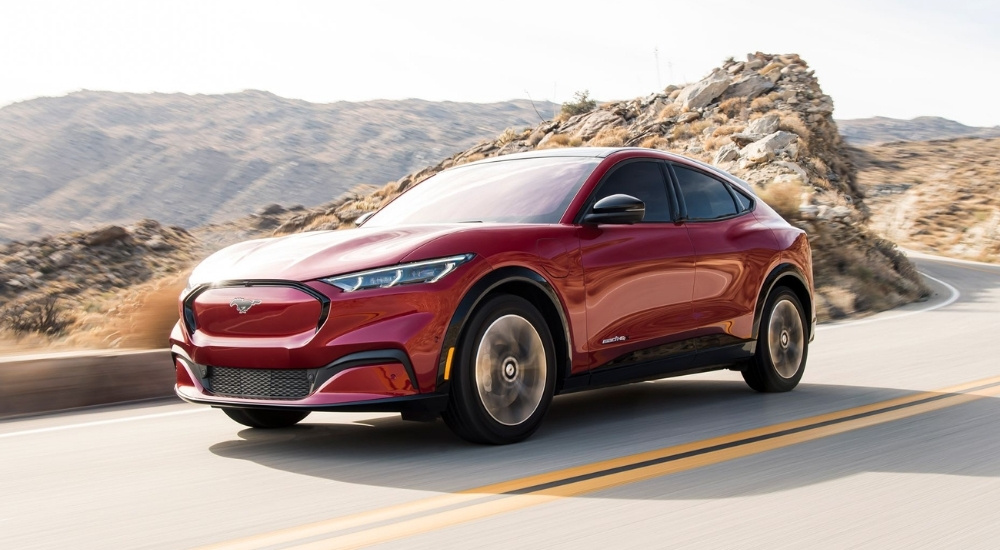
ASD entered the mainstream market in early 2020 as Ford adopted the technology for its new Mustang Mach-E. Reviving an iconic nameplate for a new EV is always a risky move, and while Ford’s pony car-inspired compact crossover does offer a blistering zero-to-60-mph time of 3.4 seconds, it does so a little too quietly. The ASD addresses this issue, giving drivers all the audio feedback they need to simulate the true Mustang experience.
Newer ASD Systems
ASD has only improved over the last few years, as brands have experimented with bold new approaches and collaborative efforts. BMW has long been a leader in ASD, but found a way to one-up itself by tapping famed composer Hans Zimmer to perfect the tech. The 2022 BMW i4 and iX were the first models to feature the BMW IconicSounds Electric system, which provides a bold new soundtrack with custom settings. Zimmer and Italian composer Renzo Vitale created a series of soundscapes with modes ranging from “Relax” and “Expressive” to “Comfort/Personal”. This represents a notable departure from the standard ASD formula. While most systems have been designed to mimic gas-powered engines, BMW IconicSounds Electric takes a more original approach with its almost orchestral arrangements.
There have been countless takes on ASD over the last decade, and the systems are only becoming more complex as the years roll on. The Hyundai IONIQ 5 N’s N Active Sound+ ASD system is easily one of the most authentic. Not only does the sport sedan simulate the traditional engine revving noise, but it can also mimic gear shifts and the pop and crackle of unburnt fuel in the exhaust system.
The Dodge Charger Daytona EV faced a similar challenge to the Mustang Mach-E, with longtime fans expecting a certain level of high performance given the model’s heritage. Dodge addresses this issue with an innovative Fratzonic Chambered Exhaust system that aims to replicate the legendary roar of the Hellcat V8, thanks to a 600-watt amplifier that physically resonates an air chamber to produce up to 126 dB of sound.
The upcoming Ferrari Elettrica will feature a similar ASD system reminiscent of an electric guitar. Instead of producing simulated engine noise, the cart will use sensors mounted on the inverter and motor assembly to capture and amplify actual vibrations. Mercedes-Benz offers a Sound Experience system in the EQS and EQE luxury sedans, with selectable settings and additional downloadable soundscapes named Silver Waves, Vivid Flux, and Roaring Pulse.
Then there’s the other end of the ASD spectrum. Standalone EV brand Polestar is doing its best Simon and Garfunkel impression, embracing the sound of silence for a more authentic experience. Volvo largely follows suit, as does EV brand Lucid. Tesla does offer a Boombox app that allows drivers to play music or custom sounds through externally mounted speakers when in Park, but it doesn’t offer any other ASD tech beyond the legally required AVAS.
Is ASD Here To Stay?
Is ASD a good idea, or is it just a flash-in-the-pan feature designed to ease the transition to all-electric models? It’s a little early to tell, but any technology that can up the appeal of the EV segment is a welcome addition to the automotive landscape. Improved charging infrastructure, lower prices, and higher-capacity batteries have made EVs a more practical alternative in recent years, but there’s still a noticeable gap between all-electric models and gas-powered vehicles in terms of driving experience.
ASD helps to close this gap and imbue EVs with a little old-school appeal. It might become dated in time, but for now, it’s a great way to prove that today’s EVs are just as powerful and satisfying as their ancestors. While the longevity and usefulness of ASD certainly leave some room for debate, it’s safe to say that AVAS will stick around for some time to come. The safety-enhancing tech plays a critical role in road safety, especially for the road’s most vulnerable users.