Active driver assistance is now standard on many cars. The most common advanced driver assistance systems (ADAS), like automatic emergency braking and lane departure warning, appear on more than 90% of new vehicles. They’re only expected to make further inroads, with the AutoPacific 2025 Future Vehicle Planner study finding that ADAS and semi-autonomous systems are among the most demanded features.
With all that demand, it’s important to understand exactly how these systems work. Understanding how common driver assistance functions work will help you use them more effectively and feel more connected to your vehicle. It also makes it easier to diagnose potential issues. In this guide, we’ll provide an overview of the engineering and concepts behind the ten most popular ADAS features, based on a 2024 report by The Partnership for Analytics Research in Traffic Safety (PARTS). Each of these technologies was found on at least 54% of new cars as of the report’s publication, and those numbers will likely increase over time, making a basic understanding of them essential.
Forward Collision Warning
This system uses sensors and cameras to monitor three pieces of information: how fast your vehicle is going, how fast the vehicle in front of you is going, and the distance between the two. If the algorithm determines a collision is likely based on the speed difference and total distance, the ADAS will warn you. Warnings could include a combination of beeping, lights, and vibrations. Some systems will even pre-charge the brakes for quicker stopping and pre-tension the seat belts for protection.
Automatic Emergency Braking
Although forward collision warning (FCW) warns you against potential collisions and prepares you for them, it doesn’t actively help avoid impacts. This is where emergency braking (AEB) comes in. Also known as crash-imminent braking, the system detects whether you are pressing the brake pedal hard enough to avoid or lessen the possible collision detected. If you aren’t, the driver assistance system will automatically apply them. This dynamic braking assistance can greatly reduce crash risks, especially in cases where the driver is distracted. Beginning in 2029, AEB will be required on all new U.S. vehicles.
Pedestrian Detection Warning
FCW is designed for vehicles, but people share the road, too. Pedestrian detection warning (PDW) is a version that uses cameras, sensors, radar, and sometimes AI specifically engineered to recognize human movements. These could include a person crossing the street, riding a bicycle, or going for a run. You will receive beeps, seat vibrations, or other warnings if the system determines that a pedestrian is in your path. The best systems can anticipate a human’s behavior even in darkness or rainy conditions. Currently, they’re most effective at speeds of 25 mph and below, though this will likely improve.
Pedestrian Automatic Emergency Braking
Pedestrian AEB is connected to the PDW system, functioning in tandem like regular AEB works with FCW. If the sensors determine a pedestrian impact is likely and you aren’t hitting the brakes hard enough, the ADAS will take over. Other AEB variations also exist, including rear AEB for backing up and intersection AEB for turning.
Automatic High Beams
Most modern cars have automatic low-beam headlights that turn on whenever the sensors don’t detect enough natural light. Automatic high beams, shorthand for “semi-automatic beam switching headlamps,” take this one step further, switching between low and high beams as needed. They use cameras and sensors to observe lighting conditions and surrounding vehicle traffic, determining whether it’s dark enough to justify high beams and whether it’s safe to do so without distracting other drivers.
Lane Departure Warning
While many of these safety systems work in a forward direction, lane departure warning (LDW) watches out for issues to either side. A camera installed near the rear view mirror tracks the lane markers on either side of the road. If it determines you’re too close to either set of markings, it will warn you with audio, visual, or other sensory methods. Like FCW, LDW will notify you of potential danger but not take corrective action. The system also needs visible paint stripes to function properly, and will not function with curbs or grass.
Lane-Keeping Assistance
This technology works hand in hand with LDW. Instead of waiting for you to take manual action to stay in your driving lane, lane-keeping assistance does so proactively. Once the cameras and sensors detect you drifting out of a lane, the system will correct the steering to get you back on track. It also provides acceleration and braking assistance if necessary. Lane-keeping systems are designed to distinguish between intentional and unintentional lane departure. For example, if you cross a dotted line with the turn signal on, the system knows you are doing it on purpose and will not try to turn against you.
Lane Centering Assistance
This is the most advanced lane-keeping ADAS technology currently available. It utilizes even more cameras and sensors to monitor whether your vehicle is centered between the painted lines. Rather than wait until you’re about to depart the lane, this system continually provides steering inputs to keep you precisely in the center of the lane. It doesn’t completely take over, though, instead providing more subtle adjustments so you can still make turns or take evasive action if needed.
Blind Spot Monitoring/Warning
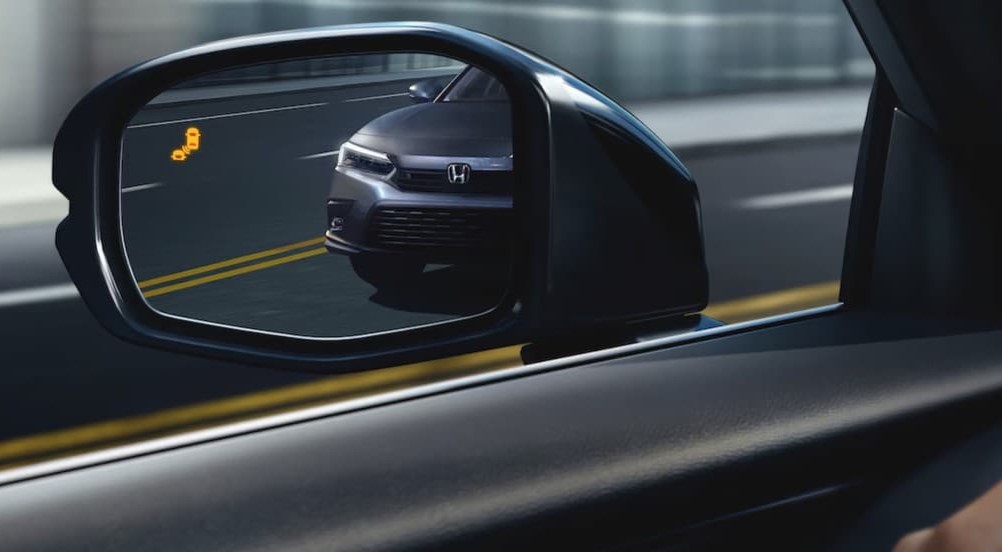
Even with your side view mirrors properly set, blind spots exist alongside your car, especially on larger vehicles like full-size trucks and SUVs. Blind spot monitoring systems use cameras and proximity sensors to determine if a vehicle is alongside you, roughly covering the area from the side mirror to 10 feet behind the rear bumper. They’ll provide a warning sound and/or indicator light before you change lanes or merge. More advanced vehicles have blind spot intervention to prevent you from changing lanes if the warning has been activated.
Adaptive Cruise Control
Regular cruise control, which keeps you at a preset speed, has become commonplace. The next generation effectively merges this technology with the cameras and sensors used in AEB. In addition to maintaining speed, adaptive cruise control (ACC) can also maintain a certain distance behind the vehicle in front of you. If that vehicle slows down, your onboard ADAS will back off the accelerator and/or apply the brakes so the distance between you remains the same. However, if that car exceeds your preset speed or changes lanes, ACC won’t match it, so you travel at your desired pace.
Technologies That Help You Drive
With the pervasiveness of ADAS, any driver who hasn’t yet driven a vehicle using the features we’ve discussed will before long. Hopefully, this overview gives you a better understanding of how they work and why they can be beneficial. Many studies have proven that they reduce accidents and injuries. Together, they form the foundation of semi-autonomous driving systems like the GM Super Cruise and Ford Cruise.
Still, as automakers frequently warn, none of these features is a substitute for paying attention and driving intelligently. Even if your vehicle has all the most common driver assistance systems and you possess an in-depth knowledge of them, remember to check your surroundings carefully, don’t drive when you’re exhausted, and use other safety features like seat belts and airbags. Think of everything as working together to help you reach your destination.