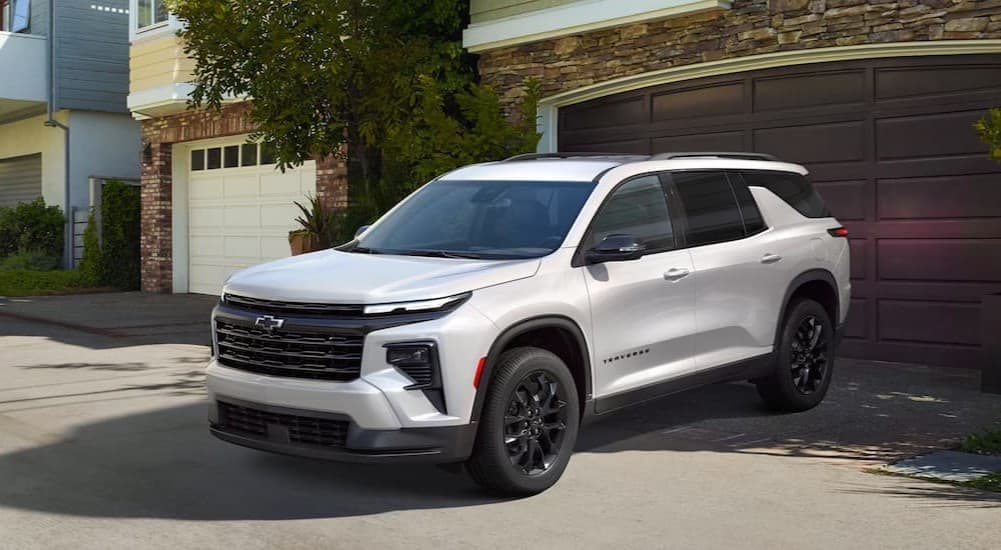
In an SUV market that now accounts for over 50% of new U.S. vehicle sales, the Chevrolet Traverse manages to rise above the noise. Introduced in late 2008, this three-row crossover has become one of the most popular SUVs, regularly selling over 100,000 vehicles annually. For anyone searching for a Chevy Traverse for sale, its continued popularity makes it a standout choice. Yet with many automakers pouring money into EVs, speculation has begun whether the Traverse will join the shift.
It’s an interesting question, especially when you consider the gas-powered Traverse has shown no signs of slowing down. As I write this, its 2025 sales numbers are on pace to challenge the single-year high of 146,264 vehicles set in 2018. Still, given the current landscape, it’s a discussion worth having, with several factors at play as to whether the time is right.
The Status of Chevy’s EV Aspirations
In 2021, General Motors set an official goal for the U.S. to transition to selling all-electric light-duty vehicles by 2035. To this end, it has introduced numerous EVs in recent years. The Chevrolet lineup now features the Equinox and Blazer EVs, a pair of two-row midsize SUVs, along with the Silverado EV truck and the soon-to-return Chevy Bolt. Badge cousins Cadillac and GMC have an even bigger range of EVs, from the sophisticated LYRIQ-V to the brawny Hummer EV. Together, this has made GM the second-ranked EV seller in the U.S., trailing only Tesla.
However, in June 2025, those 2035 aspirations took a hit, with an announcement that most of a nearly $4 billion investment in vehicle development would go towards both gas-powered and electric engines. Although the Chevrolet website still lists the 2035 EV goal, industry experts agree the gas engine investment means hitting such a target will now be difficult, if not impossible. This is part of a larger trend where automakers are re-prioritizing ICE or hybrid powertrains in response to demand. As such, the addition of a Traverse EV may no longer be a major concern for corporate bigwigs or customers.

EV Sales Surge, but Will it Last?
This leads to the larger question of whether the current market can support an all-electric Traverse. To start, I want to examine the overall state of EVs in the U.S. After years of steady increases, the total market share decreased in the first half of 2025, remaining below 10%. Although the raw volume of EV sales increased during this time, it was slower than that of other vehicle powertrains.
In the third quarter, EV sales rebounded, setting a record with over 438,000 total vehicles sold and a 10.5% market share. There’s a catch, though. The federal program, which offered up to $7,500 in tax incentives for purchasing a new electric vehicle EV, expired at the end of September, likely leading to a rush of buyers taking advantage of the offer while it was still available. It remains to be seen exactly what happens to EV sales with those incentives gone, but common sense says they’ll dip again with costs being more prohibitive.
That said, GM was among the EV automakers that saw a significant bump even as others were declining. Chevrolet’s EV numbers for Q1 2025 increased year over year, and volume-wise, GM sold approximately 40,000 more EVs in the first half of 2025 than in the same period in 2024. So even in an EV market that at best is seemingly stagnant, GM is growing, which could point to introducing more vehicles (like a Traverse EV) to take advantage.
The Three-Row Market Gets Crowded
The second aspect of the EV market involves three-row SUVs, which are what an all-electric Traverse would compete directly against. Customers now have more options than ever when choosing these EVs. As recently as 2021, the only major three-row electric SUV in North America was the Tesla Model X. Since then, the total has grown to 10, including three introduced for 2026. Here’s the full list, along with the years each debuted:
- Cadillac VISTIQ (2026) and Escalade IQ (2025)
- Hyundai IONIQ 9 (2026)
- Kia EV9 (2024)
- Lucid Gravity (2026)
- Mercedes-Benz EQS (2023)
- Rivian R1S (2022)
- Tesla Model Y (2022) and Model X (2017)
- Volvo EX90 (2025)
Even without knowing individual sales numbers, that’s a significant number of vehicles for a Traverse EV to compete against potentially. The competition may not be as fierce as it seems, though. Nine of the EVs in question are from manufacturers who are already well-established as luxury brands or are positioning themselves that way. That leaves Hyundai and Kia as the only “everyday” marques currently fielding three-row electric SUVs, leaving a larger opening for a Chevy Traverse EV than it first appears.
That’s important to consider when evaluating who Chevrolet is competing against in the ICE three-row segment. Along with Kia (Telluride) and Hyundai (Palisade), there’s the Ford Explorer, Toyota Grand Highlander, Dodge Durango, Honda Pilot, and Mazda CX-90, to name seven. It might help the Traverse to go EV and establish a foothold before other daily-driver nameplates.
The Cadillac VISTIQ: A Potential Traverse EV Guidepost
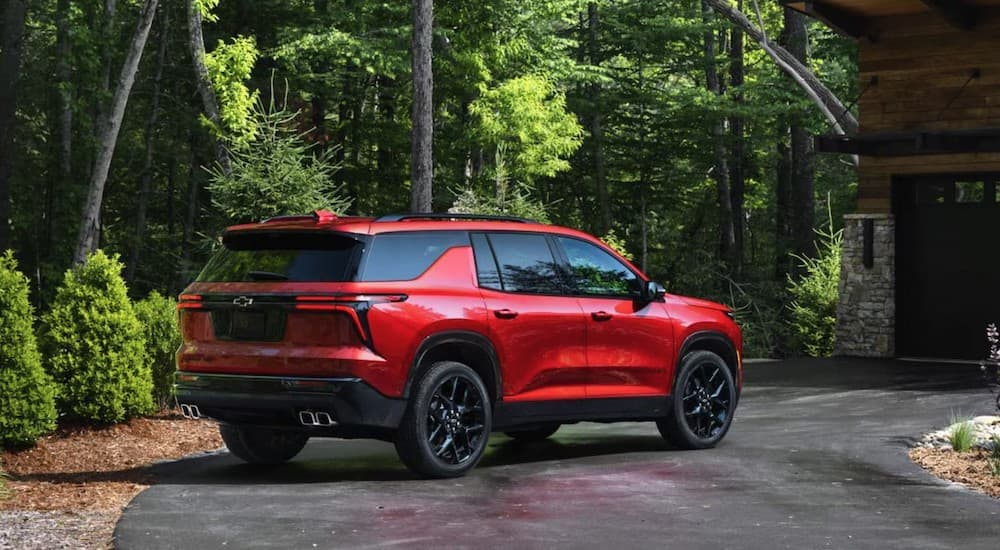
Regardless of how everyone interprets the various factors, they at least consider the possibility of a Traverse EV being on the horizon. Based on the rest of the world’s movement towards EV technology and the recognizability of the Traverse name, it’s likely to happen eventually. That means thinking about what it might look like or what it might have under the hood. And to this end, I don’t have to go far for a potential comparison, as there’s one under the same automaker umbrella.
I mentioned earlier that Cadillac, GM’s luxury nameplate, has a nice portfolio of EVs. One of those is the 2026 VISTIQ, which they just rolled out to join the Escalade IQ/IQL, LYRIQ/LYRIQ-V, and OPTIQ. Of this expanding lineup, the VISTIQ is the closest equivalent to the existing Traverse, which has three rows of seating but is a little smaller than the Escalade (and its Chevy cousins, the Tahoe and Suburban). Although a Chevy Traverse EV likely wouldn’t be as luxurious as a Cadillac VISTIQ, it’s reasonable to believe the other specs would be similar.
What are those specs? The dual-motor powertrain on the Cadillac VISTIQ can generate up to 615 hp and 650 lb-ft of torque, roughly double that of the existing Traverse. Legroom is slightly smaller than that of the Traverse, due to the battery and other equipment, but it’s still substantial, with 45.8 inches in row one and 38.7 inches in row two. Standard tech is significantly upgraded with a 33-inch curved front screen, as well as smaller climate control screens.
Additionally, second-row captain’s chairs are available on higher-end trims. I would expect safety and convenience tech on a Traverse EV to resemble the VISTIQ, where SuperCruise is standard, and you can automate up to five climate zones.
Will We See a Traverse EV?
Even with Chevrolet investing a significant amount of money in ICE and hybrid vehicles, there are benefits and advantages to introducing an electric variant of the EV. With the arrival of the Cadillac VISTIQ, there’s a potential foundation to build on, making development more cost-effective if Chevy goes that route.
But if and when Chevy does, it’s anybody’s guess. Nothing has been announced in that regard, with the biggest Traverse development in the last two years being a redesign of the ICE powertrain to use a turbo-four engine instead of a V6. Although a hybrid version of the Traverse is available in China, it has yet to arrive in North America, despite persistent rumors. Like those reading this, I can only watch and wait to see what the higher-ups decide to do.