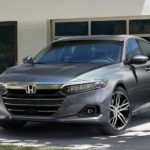
Since its introduction to American shores in 1976, the Honda Accord has established itself as arguably the premier midsize sedan. Over the decades, it’s maintained a reputation as a reliable, practical, and high-value machine. The Honda Accord has been named to Car and Driver’s 10Best list a record 39 times, and it has received numerous awards for maintaining resale value, being family-friendly, reducing carbon emissions, and more.
However, the Accord hasn’t always focused on everyday commuters and eco-conscious drivers. It has ventured into the performance realm on multiple occasions, with larger engines, unique body designs, revised suspensions, and other enhancements. This background is lesser-known but fondly remembered by those who lived it. With the 2026 Honda Accord for sale on the horizon, marking the model’s fiftieth anniversary, I wanted to reexamine its performance story, ultimately concluding with a look at the present day and what the future may hold.
Early Days: Hot Hatches, Fuel Injection, and Coupes
When this Honda arrived in the US, it wasn’t even a midsize car (or a sedan, for that matter). On the contrary, the original compact Honda Accord was arguably an early “hot hatch.” Its four-cylinder CVCC engine made 68 hp, which was impressive for the time. (A typical V8 then made only around 140 hp.) At barely 2,000 lbs, the Accord hatchback had an excellent power-to-weight ratio for jumping up to speed. Other top-end technology included an aluminum cylinder head and a five-speed manual transmission.
Honda introduced the first Accord sedan in 1979, but it didn’t immediately enter the daily driver segment. Instead, the second-gen Accord set more performance milestones. A redesigned four-speed automatic transmission debuted in 1983, boosting acceleration and fuel economy. Then, in 1985, Honda hopped on the fuel injection bandwagon for the SE-i, which became the first Accord to surpass the 100-hp threshold.
Things took another turn the following year with the third-gen Accord. It was the first FWD car to have a front and rear double-wishbone independent suspension—a road-hugging design based on Honda’s racing efforts. Exterior elements, such as the larger greenhouse and low-sitting cowl, were also sport-inspired. Fuel injection was offered on more models, and in 1988, Honda added the Accord coupe, cementing it as an athletic contender.

Turn of the Century: V6s, Hybrids, and Foreign Sport
I would argue the 1989-2006 era was the “golden age” of the Accord as a performance car. It officially became a midsize vehicle in 1989 with the fourth generation, which paved the way for even larger engines (although the hatchback was discontinued as a result). In 1995, shortly after the fifth generation came out, Honda took full advantage of its midsize status by offering the first Accord V6. This 2.7L powerplant could produce 170 hp and 165 lb-ft of torque, though it was only available with an automatic transmission.
Around this time, the Japanese market was treated to a performance-specific Accord. The original 1993 Honda Accord SiR carried the same 2.2L H22A engine as the Prelude sports coupe, delivering 190 hp. Owners could add traction control and a limited-slip rear differential (LSD) for supreme grip. The Accord SiR became so popular that it appeared in the first two Gran Turismo video games.
For the sixth generation, Honda added two more Accord performance variants in foreign markets: the Euro R for Japan and the Type R for Europe. Each used a retuned H22A engine, producing 217 and 209 hp, respectively. They also had a stiffer suspension, a standard LSD, a dual exhaust system, Recaro sport seats, and other premium elements.
US customers never did receive these vehicles (which is especially ironic given the Accord SiR coupe and wagon were made in America), but they had plenty else to look forward to. The sixth-gen Accord of 1998-2002 also broke the 200-hp barrier with its available 3.0L V6 engine. Things got bigger in 2003, when the seven-generation Accord offered a V6 with a whopping 240 hp. Not content with this, Honda introduced the first Accord Hybrid in 2005, which cranked the V6 up to 255 hp and 232 lb-ft of torque.
Hyper-Productivity Age: Turbocharging Takes Over
In terms of sheer numbers, you won’t see better performance from a Honda Accord than during this span, which started with the eighth generation. Its engine upgrade option was a 3.5L V6 that set the new standard, initially generating 268 hp before a tune-up increased it to 271 hp. And while previous supersize engines were only connected to an automatic transmission, Honda also offered the new V6 with a manual transmission.
Honda wasn’t done, as the ninth generation (2013-2017) further tweaked the 3.5L V6, ultimately reaching 278 hp and 252 lb-ft of torque. The automaker also reintroduced the hybrid powertrain, as well as a PHEV. However, in a sign of things to come, Honda paired the electric motors with the smaller 2.0L inline-four engine. As such, the hybrid models only peaked at 212 hp.
The tenth generation was a mixed bag for performance fiends. The worst news was that Honda ditched the V6 as part of a company-wide shift away from this engine technology, and it also eliminated the coupe body style. On the other hand, the 2.0L engine was equipped with a turbocharger, which enabled it to rival the old V6, producing 252 hp and 273 lb-ft of torque. Honda also upgraded the automatic transmission to a ten-speed, and the Accord Touring came with an adaptive damper system to improve handling and control.
The Current State of the Accord’s Performance
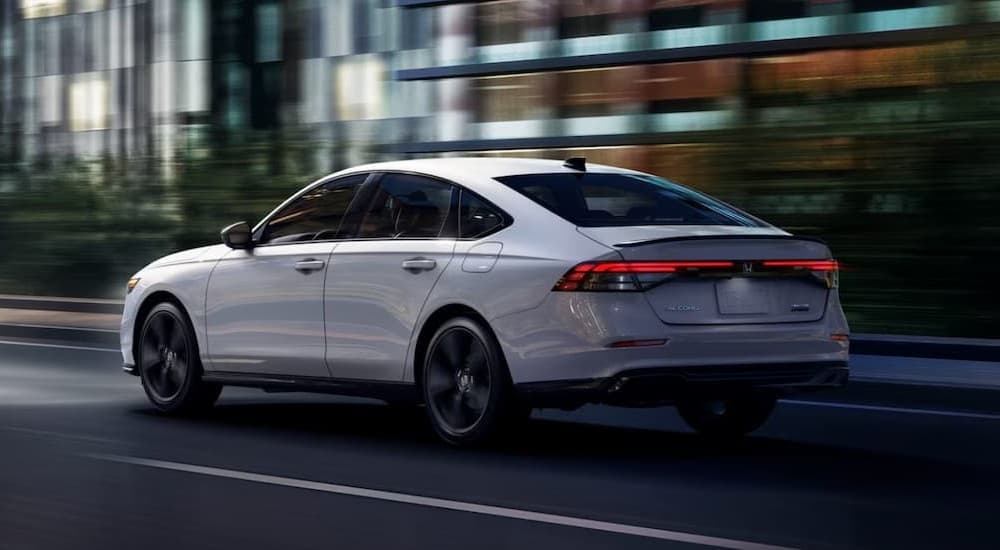
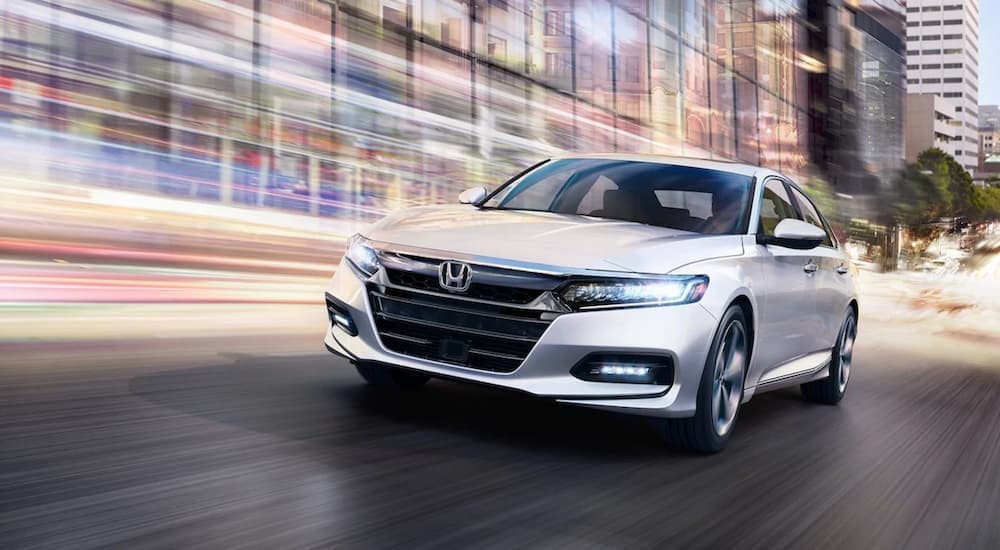
Unfortunately, people who lived through the biggest, loudest years of the Honda Accord don’t have much to cheer about these days. When the eleventh generation came out in 2023, it eliminated both the 2.0L turbo-four engine and the manual transmission. Now, the most powerful Honda Accord powertrain is the hybrid connected to a 1.5L turbo-four; its 204 hp and 247 lb-ft of torque pale in comparison to the greats. The Sport and Sport-L trim levels offer larger wheels and a few other amenities, but it’s nowhere near enough to consider either a performance vehicle.
Instead, Honda has focused on the Civic Type R hot hatch and the Civic Si sedan for its performance fix. I see two primary reasons for this. One, with Honda eliminating V6 engines, a compact car lets enthusiasts get more from the turbo-fours they now specialize in. Second, the Civic’s smaller size also lends itself better to agile, sporty handling than the Accord, leaving the latter as the odd car out.
Will We Ever See Another Performance-Oriented Accord?
This begs the question of whether Honda might ever let the genie back out of the bottle and give the Accord some high-performance swagger again. I think the answer depends on one thing: how much Honda decides to squeeze out of its hybrid powertrains. Over half of all Accords sold are hybrids, and Honda plans to discontinue gas-only engines in the US by 2040. As things stand, Honda has primarily focused on tuning the Accord Hybrid for fuel efficiency, with the 2025 model achieving an EPA-estimated 48 MPG combined.
However, theoretically, it could upgrade the hybrid system or pair it with a larger turbo-four engine, if customers demand it. The current Accord powertrains are expected to carry over for the 2026 refresh, so don’t expect a new performance-oriented Accord anytime soon. Such a vehicle remains at least a possibility, though, especially if competitors like the Toyota Camry and Hyundai Sonata achieve success with their more muscular powertrain options. I’d love to see the return of an Accord designed for speed, and I hope others share this sentiment.