Recently, U.S. drivers have been hearing a lot about microcars. Defined as a very small car with an engine of 700cc (0.7L) or less, these tiny cars first became popular in the mid-20th century and are now seeing a resurgence in Europe and China as modern EVs. They’ve been trumpeted as a practical, efficient urban driving solution to address congestion. According to data from Frank & Sullivan, 1.45 million microcars were sold globally in 2025, and this number is expected to continue rising.
Microcars haven’t made much of a mark stateside, but that could change soon. Several models have already been introduced to U.S. customers, and more are in development. With the true arrival of microcars appearing imminent, we wanted to look at the current state of microcars, why they aren’t widespread in the U.S., and what’s on the horizon.
A Classic Low-Speed Urban Vehicle
Microcars may feel new, but they date back as far as 1895. Just like EVs, they’re a lot older than you might think. Voiturette was known for making miniature automobiles between 1895 and 1910. Cyclecar then picked up the torch through the late 1920s, with each brand becoming a generic regional term for ultra-small cars.
However, the first true wave came in Western Europe and Japan following World War II. Motorcycles also surged around that time, and the microcar became an alternative for those who loved the nimbleness of a motorbike but wanted the weather protection of a car. They remained fashionable through the 1950s, mostly produced by startups and smaller companies. At that point, full-size cars became dominant again, thanks in part to new “subcompact” vehicles like the Mini and Fiat 500 that were plenty nimble while offering more power and space.
It wasn’t the end of the story, though. There were several attempts at electric microcars between the 1970s and the early 2000s, including the 1974 Sebring-Vanguard CitiCar and the 1999 Corbin Sparrow. Also, in 1992, the European Union created the quadricycle vehicle registration class. Perhaps inspired by Japan’s “Kei car” legislation of the 1950s, this legislation designated microcars as closer to mopeds and motorcycles, thereby lowering licensing, registration, tax, and insurance requirements.
This set up EV microcars perfectly for a resurgence. With urban congestion, emissions, and affordability becoming even greater concerns, the door was wide open, and people responded. Electric-powered microcars are ideal for the narrow streets of Europe and Asia, which have always been conducive to smaller vehicles.
Why Haven’t Modern Microcars Been Successful in the U.S.?
Yet by and large, microcars haven’t made it to the U.S. There are few legitimate options at this point, with most of the “microcars” here just being modified golf carts and buggies. There are many reasons driving this.
Americans have a taste for larger vehicles like trucks and SUVs, and most consumers simply aren’t interested in tiny cars. Since gas prices are much lower in the U.S. than in other countries, a micro EV is less beneficial. Because the infrastructure isn’t set up stateside and demand is lower than for full-size cars, it’s much harder for automakers to produce microcars profitably. American roads are much wider than those in Europe and Asia, making a tiny car even less necessary for getting around. Microcars have also faced an uphill battle meeting NHTSA vehicle crash safety standards, which are often more stringent than those abroad.
Most current “microcars” available to U.S. customers are actually classified as low-speed vehicles (LSVs) or Neighborhood Electric Vehicles (NEVs). These are only approved for speeds up to 25 mph. Furthermore, they can only travel on roads with a posted speed limit of 35 mph or less. This severely limits their usability and practicality, especially if you mainly do high-speed driving.
Microcars Prepare to Launch Stateside
Even with all those things working against U.S. microcars, there is hope. Although not as powerful as their European counterparts, a handful of microcars have been approved as street-legal LSVs and NEVs, mostly from startup companies just like the original. These include the two-seat Polaris GEM e2 and Eli Zero, the one-seat Commuter Cars Tango T600, and several four-seat models from Wink Motors (Mark1, Mark2, and Sprout).
As you might expect, the vehicles are small and have limited range. For example, the Eli Zero is 4.5 feet wide by 7.4 feet long, and its typical range is 60 miles. Availability is also extremely limited — as I write this, only 12 Tango microcars are in use, though there is currently a waiting list of over 2,000 people. But they represent a small step toward micro-vehicle adaptation.
Several other microcars are in development, both from startups and some of the biggest automotive names, with the intent of gaining U.S. approval. Here’s a look at the most interesting microcars that may see the light of day.
Honda Micro EV
This concept car was recently displayed at the Japan Mobility Show, and although there are no current plans to put this specific model into production, it could be a preview of future microcars. The bench seat is integrated into the body to maximize legroom, and you can fit another personal mobility device (like a scooter or skateboard) under the seat. Elsewhere, the Honda N-One is an established Japanese Kei car, and this summer, Honda will begin production on the Fastport eQuad for U.S. and European delivery services.
Toyota FT-Me
In early 2025, Toyota debuted its microcar concept, which is a two-seater that can travel up to 28 mph (exceeding the LSV/NEV barrier) and is less than 98 inches long. The passenger seat is removable for cargo storage, and Toyota is aiming for a minimum all-electric range of 62 miles. It’s also a technological marvel with standard smartphone-as-key and solar panels on the roof to recharge the battery.
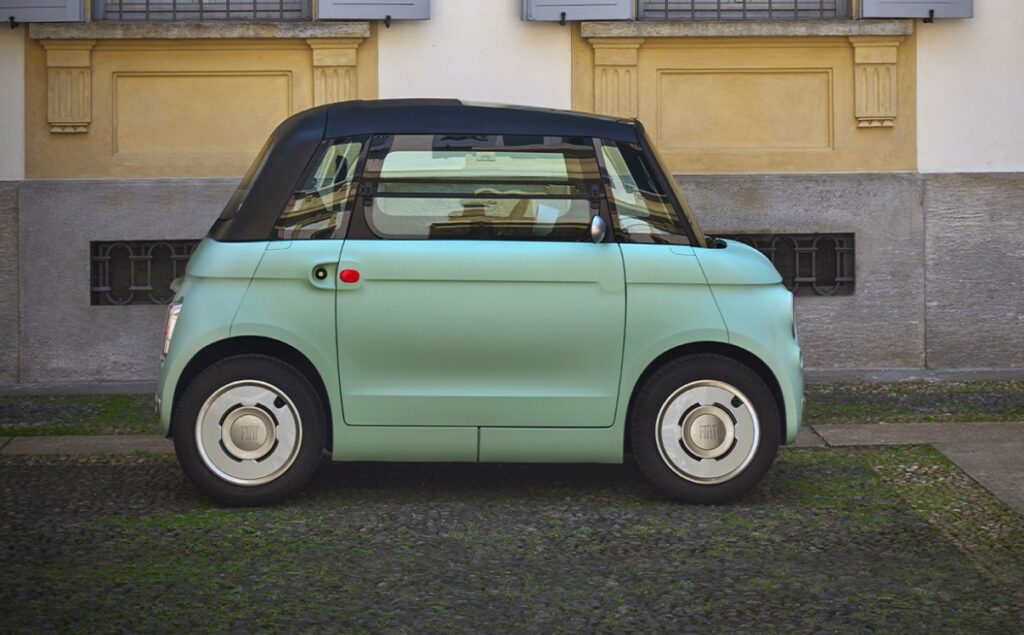
Fiat Topolino
The Topolino has been available in foreign markets since 2023, but Fiat plans to bring it to the U.S. by 2027, making it the first vehicle on this list with a target release date. It uses an eight-hp electric motor for a top speed of 28 mph and a range of 47 miles. The Topolino offers a hardtop/sunroof or a soft top, and you can choose traditional doors or red-carpet ropes. Speculation is that pricing will start around $12,000.
Wink Motors
With its existing models already sold out, Wink Motors is plowing ahead on new microcars. The Mark3, a four-passenger hatchback that is street-legal in all states except New York (ironic, since that’s where Wink Motors is based), is available now for presale. It’s almost as large as the Mini Cooper and offers an 85-mile range, air conditioning, alloy wheels, and optional solar charging panels. The Sprout3 is also in development, which is a three-passenger microcar with increased range and a MacPherson front suspension.
Gazing into the Microcar Crystal Ball
Microcars are closer than ever to being a significant part of the U.S. landscape. The pending arrival of the Fiat Topolino may well be the most important domino, as its success could determine whether other overseas microcars, such as the Microlino, Suzuki Ignis, Kia Ray EV, and Nissan Sakura, eventually follow. The fact that automakers familiar to U.S. drivers are at least exploring the possibility is another positive sign.
That said, many factors will ultimately influence whether microcars catch on, including safety and emissions regulations, costs, and vehicle capability. Then there’s the inevitable task of getting people who have grown up on massive vehicles interested in the exact opposite. The potential is there, though, and the picture should become a lot clearer over the next few years.