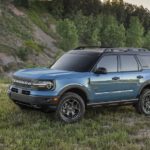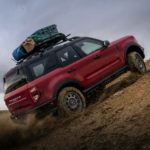
As part of the triumphant return of the Ford Bronco nameplate, Ford introduced a little brother that has become successful in its own right. The Ford Bronco Sport debuted in late 2020 as a subcompact SUV alternative to the traditional body-on-frame Bronco, offering light to mid-level off-roading ability and a strong road presence. It was huge out of the box, outselling the Bronco in 2023 and 2024 according to Ford Authority. However, while Bronco sales are growing, the Bronco Sport numbers have flattened.
While total numbers are still good for now, Ford needs a way to kickstart the flagging sales before they become a problem. One solution currently being floated is the addition of a hybrid powertrain. However, it may be more than rumors. In July 2025, Ford introduced PHEV and EV versions of the standard Bronco in China, featuring an exterior design more closely resembling that of the Bronco Sport. And in August 2025, Automotive News reported that a Bronco Sport Hybrid could be available for sale as soon as the 2028 model year, a detail that may matter to shoppers searching for a Ford Bronco Sport for sale.
With a hybrid now at least a possibility, the bigger question arises of whether the time is right. For me, the short answer is yes — but why? Furthermore, if and when the Bronco Sport Hybrid arrives, should it resemble the current vehicle or go its own way? Today, I’ll aim to explain why it’s time for a Bronco Sport Hybrid and look at the possibilities for this hopefully-soon-to-arrive machine.
Hybrid Sales Continue to Rise
The biggest reason to support a Bronco Sport Hybrid is that, across the board, more Americans are demanding hybrids. Even as EV sales lag, hybrid vehicle sales soar. According to data from Wards Intelligence and the U.S. Energy Information Administration, mild hybrids accounted for 12% of new light-duty vehicles in Q1 2025, with PHEVs accounting for another 2%. GreenCars adds that in Q2 2025, hybrid sales jumped another 36 percent.
There are several factors as to why hybrids now account for nearly a quarter of new vehicle sales. They largely operate like traditional gas-powered cars, yet achieve significantly better fuel mileage. Drivers enjoy familiarity, long-term savings, and a smaller carbon footprint all in one.
Furthermore, owners of hybrids never experience “range anxiety,” especially in rural areas where public charging stations are scarce. They can almost always find a gas station nearby to fill up. The recent expiration of federal EV tax credits has also made all-electric vehicles more cost-prohibitive; as a result, some mild hybrids are now comparable in price to gas-powered vehicles. Even in a vacuum, a hybrid is an attractive choice, leaving automakers hustling to get new ones to market.
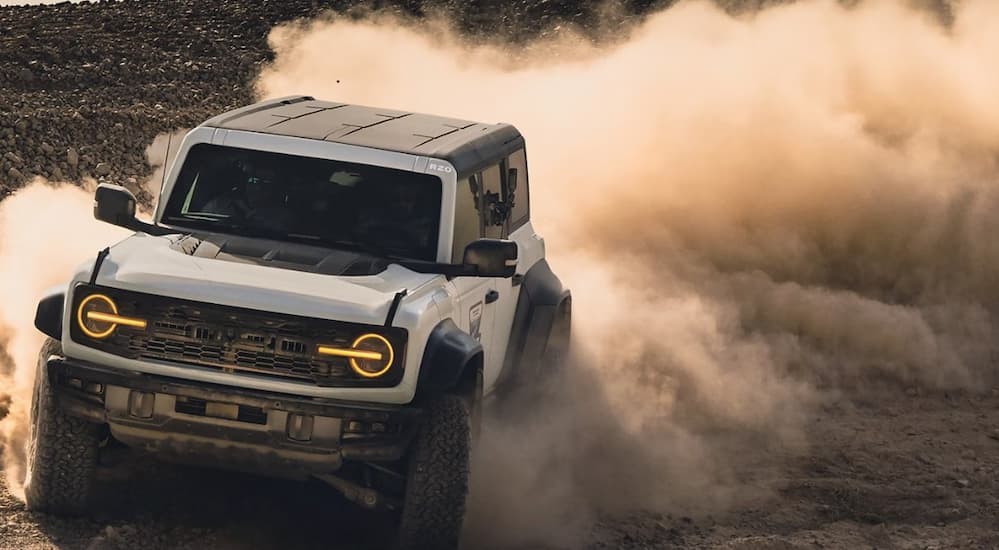
Bronco Rivals Jump On the Hybrid Train
This highlights another compelling reason for Ford to introduce a Bronco Sport Hybrid: they need to keep up with rivals. Hybrids in the compact SUV market are much more commonplace now than when the Bronco Sport first entered production. Two of the most popular SUVs, the Toyota RAV4 and the Honda CR-V, have achieved this status in part because of their hybrid options. The RAV4, along with the Jeep Compass, is available in both mild hybrid and PHEV variations. For 2026, Toyota is making the RAV4 lineup exclusively electrified, removing gas-only powertrains for the model year.
That’s just the tip of the iceberg. The Subaru Forester introduced its first hybrid offering for the 2025 model year, and the Subaru Crosstrek followed in 2026. Kia, Mazda, and Hyundai each have multiple small hybrid SUVs either on the market or in the pipeline. Beyond this, there are reports that Nissan may collaborate with Ford and/or Stellantis to develop a hybrid compact crossover version of the Rogue.
Ford stated in April 2024 that it intends to have at least one hybrid powertrain available in every vehicle in the North American lineup by 2030. This statement was made after the 2023 fiscal year, which saw Blue Oval hybrid sales jump by 42%. With hybrids continuing to gain market share and the Bronco Sport starting to get left behind on the powertrain front, the sooner the better for updating this vehicle — at least theoretically.
What Could the Ford Bronco Sport Hybrid Be?
When thinking about what a Ford Bronco Sport Hybrid might entail, the devil is in the details. Due to its name, people often associate the Bronco Sport with its body-on-frame SUV heritage. To be fair, the Bronco Sport looks a lot like the Bronco, offers most of the same trim levels, and offers similar packages like the Sasquatch off-roading and Class II trailer towing loadouts.
Beneath the sheet metal, though, the Bronco Sport shares a unibody Ford C2 platform with the 2025 Ford Escape compact crossover and the 2025 Maverick compact pickup. Notably, these two rides are already available with hybrid powertrains. The Escape offers the same two gas-powered engines as the Bronco Sport, but adds hybrid and PHEV variations. On the Maverick, a hybrid is standard, with the option to upgrade to the Bronco Sport’s turbo-four gas engine.
Unless Ford plans to spin the Bronco Sport Hybrid off to a unique platform — which is unlikely given prospective development costs — it seems the Maverick and Escape will at least serve as inspiration for a future Bronco Sport Hybrid. With that in mind, here are the specs of the two powertrains currently on the Bronco Sport, along with the Maverick and Escape hybrids:
- Bronco Sport Engine #1: 1.5L EcoBoost turbocharged I-3, 180 hp, 200 lb-ft of torque.
- Bronco Sport Engine #2: 2.0L EcoBoost turbocharged I-4, 250 hp, 280 lb-ft of torque.
- Escape/Maverick Hybrid: 2.5L I-4, 191 hp, 155 lb-ft of torque.
- Escape PHEV: 2.5L I-4, 210 hp, 155 lb-ft of torque.
In terms of sheer power, the current mild hybrid for this platform is arguably worse than the base gas engine. The horsepower levels sit between the gas engines, but torque is a major concern, making acceleration sluggish. The primary benefits of the current hybrid setups are improved fuel mileage and extended range. The 2025 Escape hybrid option delivers an EPA-estimated 39 MPG combined with up to 558 miles of range, while the Escape PHEV achieves 40 MPG equivalent and up to 597 miles of range. By comparison, the 2025 Ford Bronco Sport returns an EPA-estimated fuel economy of 27 combined MPG and offers roughly a 400-mile range.
Of course, an eventual Ford Bronco Sport Hybrid will arrive as part of a larger redesign — and perhaps more importantly, the Escape is being discontinued after the 2026 model year. This is my best hope: that, no longer constrained by accommodating the everyday Escape model, Ford can open things up with the new hybrid platform and give the Bronco Sport a jolt (and the Maverick by extension). When I think of the Bronco name, I think of storming over the roads and trails as adrenaline pumps through my veins. It’s hard to imagine doing that in a vehicle with less torque than my 2017 Hyundai Sonata (no offense to Hyundai). My fingers are crossed for this dream to come true.
Awaiting a Bronco Sport Hybrid
Even in a best-case scenario, as of this writing, it appears the Bronco Sport Hybrid is at least two calendar years away. Given the shared platform, Ford could potentially drop a hybrid powertrain into the Bronco Sport right now. I’m staying optimistic that the delay, even in the face of massive hybrid demand and competition, means Ford is putting the effort into doing this right and creating a worthy powertrain. Time will tell whether this is the case.