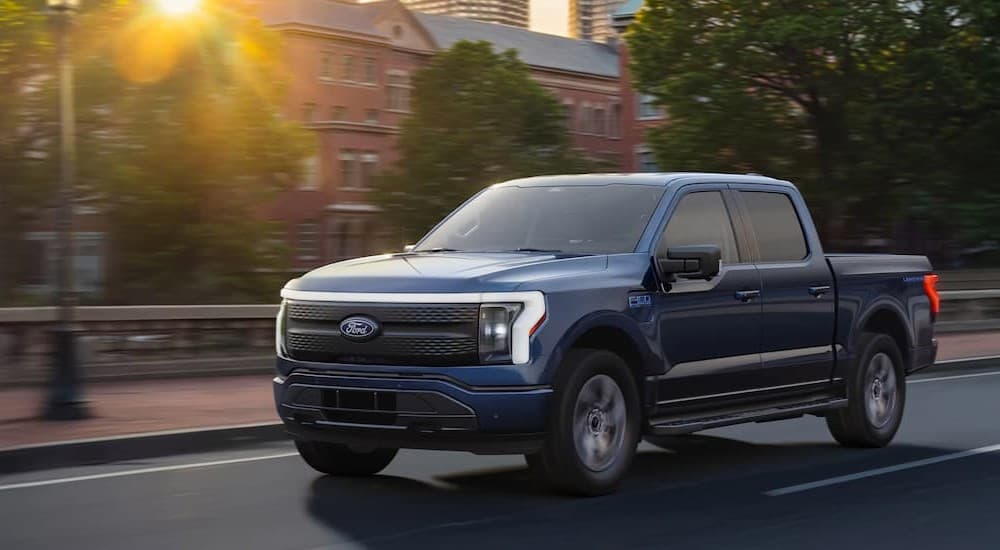
Ford snuck a lump of coal into the auto industry’s collective stocking in late December with a shocking pre-holiday announcement: the F-150 Lightning would not be returning for the new year, at least in its current EV form. After just four years on the market, Ford is ending production of the market’s first all-electric pickup amid reports that the automaker will lose around $5 billion on its EV business for the second year in a row. “Rather than spending billions more on large EVs that now have no path to profitability, we are allocating that money into higher-returning areas,” said Ford Blue president Andrew Frick.
The industry’s first full-size, mass-market electric pickup made waves upon its debut back in 2022. However, the truck has been consistently plagued by challenges and low sales, with Ford only managing to move an average of 25,000 units per year. The high-water mark was 2024, when the brand sold almost 34,000 units. However, low demand and a poorly timed fire at one of Ford’s key aluminium suppliers led to the indefinite pause of Lightning production in late 2025. With less than 100,000 total sales to its name, it’s fair to label the F-150 Lighting as an ambitious yet failed experiment. The full-size EV held a lot of promise, and if there was any automaker that could pull it off, we would have put our money on the country’s bestselling pickup brand. Unfortunately, Ford faced its fair share of challenges in getting the Lightning off the ground.
The F-150’s demise raises an interesting question about the feasibility of large, all-electric pickups and SUVs in general. While subcompact, compact, and midsize EVs have found a fertile market, full-size trucks and SUVs are a different story altogether. Many of the market’s largest models are still powered by either pure gas-powered engines or hybrid setups, and the Lightning’s recent failure means that’ll probably remain the case for some time to come. While it might seem a little macabre, a little post-mortem can go a long way towards illustrating Ford’s follies and help us understand what the future might hold for large all-electric pickups and SUVs. We’ll also look at some of the key challenges that faced the Lightning EV, consider what comes next, and learn how one pickup brand is already ahead of the curve when it comes to the next generation of electrically powered pickups.

Current Challenges
The Ford F-150 Lightning looked like the truck of the future, but problems of the present played a significant role in its failure. Let’s take a look at some of these.
Big EVs Need Big Batteries
While all-electric vehicles have become increasingly powerful and have steadily improved their range to an average of around 300 miles, they’re still limited by their most expensive component: the battery. An EV’s battery can account for 20% to 40% of its total cost, and the price increases with the size of the vehicle. The subcompact Nissan LEAF crossover, which is often cited as one of the most affordable EVs on the market, might only cost around $30,000, but its 75-kWh battery accounts for more than a third of the price, with an estimated replacement cost of $12,000 due to the high cost of the rare elements required for production.
Now, consider the fact that the F-150 Lightning weighs 2,500 lbs more than the LEAF, and it’s easy to see how battery cost can be such a limiting factor. The Lightning’s battery ranged from 98 kWh all the way up to 131 kWh, with the largest option ringing in at around $35,000. That’s a serious chunk of change by any measure, and meant that a top-of-the-line F-150 Lightning Platinum would retail for $87,000.
Failing the Truck Test
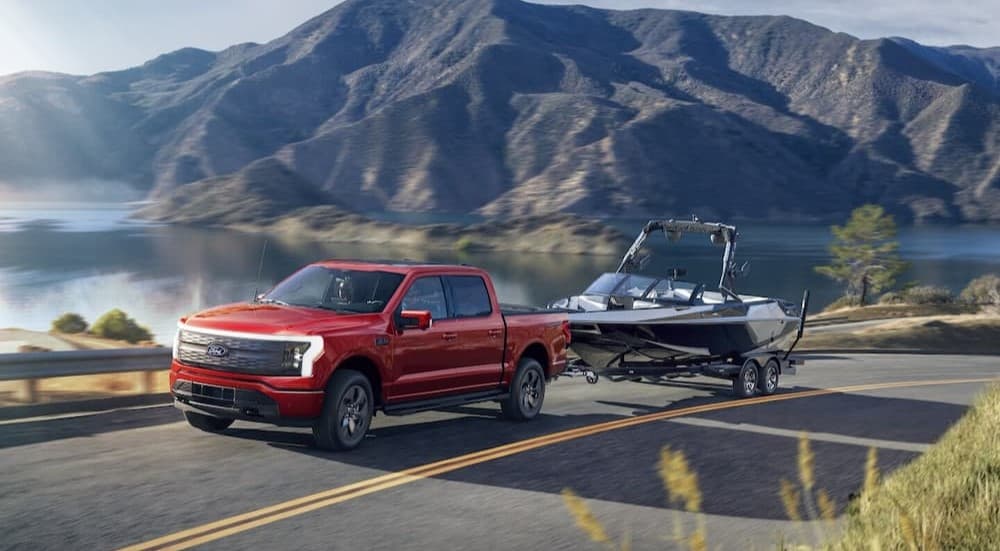
There is also a notable gap in the truck-like qualities of larger pickup EVs and SUVs like the F-150 Lightning. Towing was touted as the Lightning’s strong suit, with a 2019 prototype famously pulling a 1.25-million-lb train. The production model failed to offer even a fraction of that. Even the most powerful, well-equipped trim topped out at 10,000 lbs. That’s a far cry from the traditional F-150’s 13,500-lb maximum towing capacity.
While drivers are beginning to come around to the advantages of EV technology, driving range can still be a real sticking point for many. This is especially true of models in the full-size pickup segment, which has traditionally traded on their towing and hauling prowess. The F-150 Lighting was no slouch in terms of towing, but taking advantage of the truck’s full towing capacity could see it sacrifice up to half of its total range. The Lightning already trended slightly below average, with the base model offering just 240 miles of range. While upper trims posted closer to 320 miles, the actual figure could sink as low as 150 miles when towing a full load.
Lack of EV Infrastructure
While Ford’s first EV pickup lacked a dedicated off-road trim like its gas-powered cousin, it could still hold its own on challenging terrain thanks to its AWD setup, rear locking differential, and underbody protection. There’s just one problem when it comes to exploring your favorite off-road locale behind the wheel of an EV. While it’s easy to strap a few cans of spare gas onto a gas-powered model, you’re unlikely to find a DC fast-charging station when you’re navigating through the wilderness. That’s a pretty specific scenario, but charging-related anxiety isn’t limited to those who enjoy off-roading.
While we’re wary of making any overarching statements about the pickup-driving public, the data suggests that those who gravitate towards full-size models tend to live in more rural areas where EV charging infrastructure is not yet commonplace. It’s tough to sell someone a truck that can’t be easily refueled as part of their daily routine. While there are plenty of home-based charging options, having to plan around a mid-journey pit stop isn’t anyone’s idea of convenience. This is one of the key reasons why brands are now looking towards a new type of hybrid construction that could allow future full-size EVs to check all those pickup boxes while offering the sort of range that would put many gas-powered models to shame.
Is EREV The Answer?
The F-150 Lightning might go down as an ambitious, yet failed experiment, but it could also pave the way for the next generation of electric-assisted Ford trucks. While the Lightning isn’t long for this world, the brand isn’t ready to throw in the towel just yet, and has already announced plans for a new hybrid replacement in the form of an extended-range electric vehicle (EREV). Unlike EVs, which rely on a large battery pack and electric motors to handle all propulsion duties, EREVs take a more hybrid-like approach by employing a gas-powered engine. While hybrids use a little internal combustion to directly power the wheels, the engine in an EREV acts as a generator, used solely to recharge the vehicle’s battery. EREV models typically offer some amount of all-electric range, but can also tap the gas engine to provide plenty of extra mileage as the battery is depleted. It might seem like a step in the wrong direction compared to some all-electric models on the market, but the EREV approach allows brands like Ford to address the persistent issue of range anxiety.
Ford wouldn’t exactly be breaking new ground with the introduction of an EREV-ified F-150. Ram’s upcoming 1500 REV will be the first mass-produced EREV to hit the market in late 2026, and could serve as a promising proof of concept with a V6 engine and a set of electric motors that will give the full-size truck 647 hp, a 14,000-lb towing capacity, and 145 miles of all-electric range. Those are compelling stats, but it’s the Ram 1500 REV’s total range that could revolutionize the full-size segment. Ram claims it will offer 690 miles of range thanks to its EREV design, which is a nearly 200-mile improvement over the current long-distance champ, the Lucid Air Grand Touring.
The Ram 1500 REV was originally going to be accompanied by a Lightning-like pure EV. At the time, the 1500 REV was called the Ramcharger, and the pure electric truck was dubbed the Ram REV. However, being a little late to the game can have its advantages. Ram witnessed the F-150 Lighting’s underwhelming sales and halted development of the full-electric REV. It dropped the Ramcharger’s name and moved the REV name over to the EREV truck. (Confused yet?)
Volkswagen is also set to enter the EREV fray with the introduction of a new Scout brand, focused on developing truck and SUV models that embrace innovative tech. Ford has already begun the marketing push for the next-generation Lightning, which, at least for the time being, seems like it’ll retain the electrically inspired name. The 2027 Lightning will certainly look much different under the hood as the automaker embraces the EREV design, which it describes as a series plug-in hybrid powertrain. Details are still tough to come by, but two key takeaways paint a pretty promising picture, with Ford citing 700 miles of range and the ability to “tow like a locomotive,” perhaps for real this time.
The Next Step
Automakers have a lot to learn from the F-150 Lightning’s failure. While the short-lived pickup will likely be remembered as an expensive misstep on the part of Ford, you’ve got to break a few eggs when you’re trying to craft the truck of the future. The F-150 Lightning serves as a great example of what not to do when crafting a full-size pickup EV, and it looks like the market is already learning a valuable lesson from Ford’s missteps with models like the Ram 1500 REV.
Ford has learned that all the expensive marketing campaigns and eco-friendly promises don’t amount to much if its electric pickup fails to fulfill the basic duties of a pickup truck. Sedan and SUV drivers might be content to sacrifice a little utility to usher in a new generation of sustainable vehicles, but pickup owners tend to be a more demanding crowd. Between its high price, subpar towing ability, and low driving range, the F-150 Lightning was always going to be a tough sell on the U.S. market.
There are some bright spots on the horizon for Ford’s EV ambitions. In addition to the next-generation Lightning, the automaker plans to introduce a new, affordable midsize pickup EV in 2027. Built on Ford’s Universal EV Platform, the as-yet-unnamed pickup is expected to retail for around $30,000, which could go a long way towards widespread EV adoption. While the forthcoming truck doesn’t address any of the issues raised by the Lightning’s cancellation, it’s certainly a step in the right direction as Ford works to remain relevant in a quickly changing market.